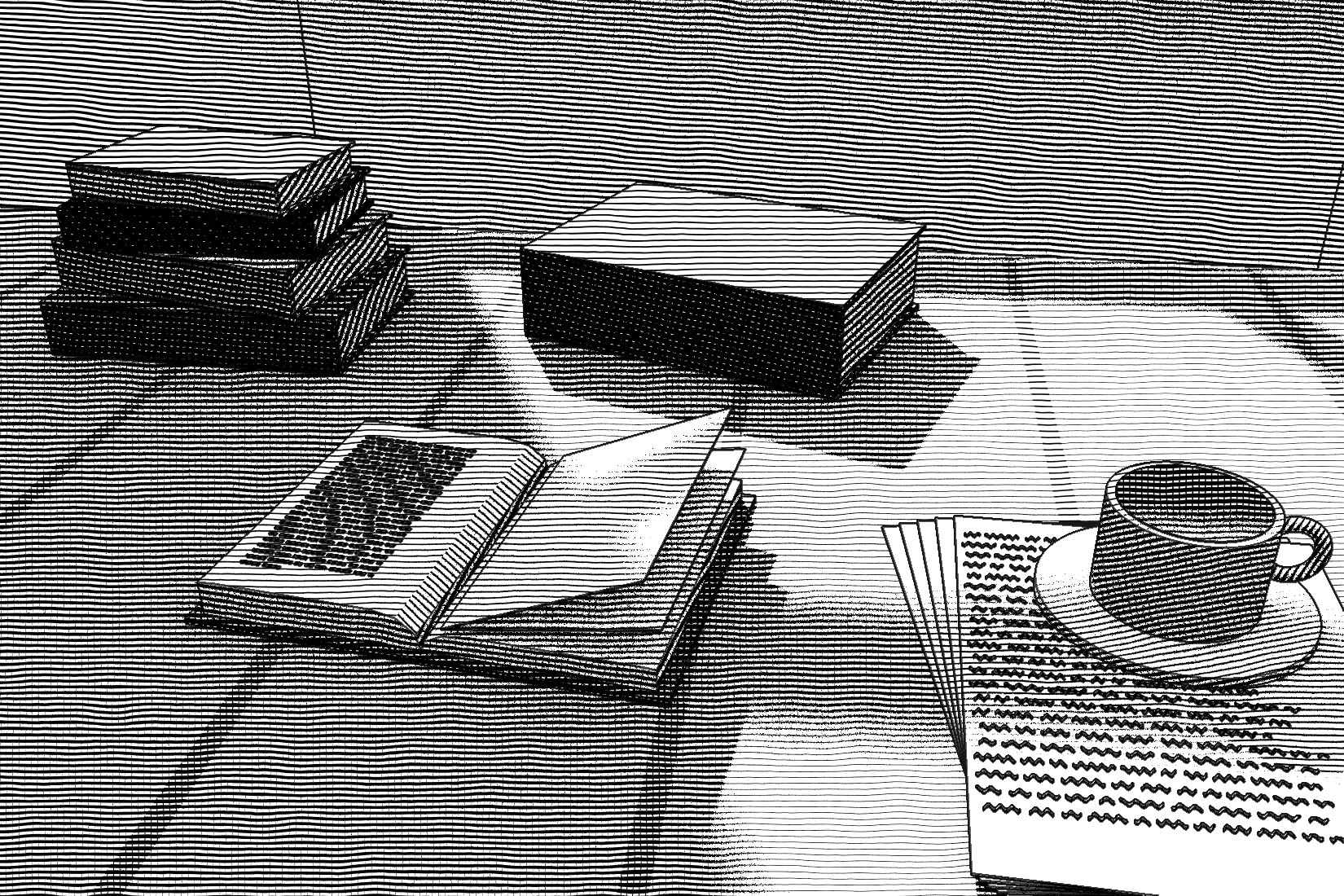
Every margin is an invitation, and some readers accept it more readily than others. Engraving by Sunniva Holt
The book cost less than the coffee I drank while deciding to buy it. It was a 1938 handbook called Weather Lore of the Halbridge Approaches, written by a harbor pilot named Oswin Tarrant, and it had been sitting for who knows how long in the two-for-one crate outside a secondhand shop on Chandler Street in Westmere. I did not want it for the weather. I wanted it for page 41, where somebody had underlined Tarrant’s confident claim that sea fog in the outer roads “comes in on the flood and goes out on the ebb” and written beside it, in soft pencil: Wrong. Ebb, not flood. Ask anyone at the Skerrow light. R. D., 1952.
Below that, in blue ink and a rounder hand: Not at Westmere it doesn’t. 1971. And below that, squeezed into the last half inch before the edge of the page, in the ballpoint of someone who clearly felt the matter had gone on long enough: You are both right. Depends on the month. Wind matters more than tide. M., 1994. Three readers who almost certainly never met, spread across 42 years, conducting an argument about fog in a strip of paper an inch and a half wide. Tarrant’s text, set in a handsome and entirely certain typeface, never answers them. It cannot. It was finished in 1938. The margin was not.
Agata Kowalczyk is a contributing writer who covers memory, language, and the history of reading, with a particular weakness for footnotes. She spent 11 years as a rare-books cataloger at the Halbridge Athenaeum and is the author of Other People’s Pencils, a study of the notes readers leave in secondhand books. She lives in Westmere, in a house with a damp cellar she calls “an archive with opinions,” and buys used books only if someone has already written in them.
Page 41 of a 1938 weather handbook, with its readers’ notes
XI. OF FOGS IN THE OUTER ROADS
Sea fog in the outer roads comes in on the flood and goes out on the ebb,
and the prudent master will time his passage accordingly.
[pencil, right margin] Wrong. Ebb, not flood. Ask anyone at the Skerrow light. R. D., 1952
[blue ink, below] Not at Westmere it doesn’t. 1971
[ballpoint, against the edge] You are both right. Depends on the month.
Wind matters more than tide. M., 1994
[pencil, faint, beside the heading] a small drawn hand, pointing at “prudent”
The page that sold me the book. The printed text has not changed since 1938; the argument around it ran for at least 56 years. Collection of the author
I have been thinking about that page for most of a year, partly because it is funny and partly because it is the best argument I know for the thing this magazine is named after. A margin is the part of the page that has not yet made up its mind. The text in the middle states; the margin queries, corrects, cites, qualifies, jokes, and occasionally loses its temper. When a writer puts notes there—or at the foot of the page, or at the back of the book, or, as we do, in the strip of screen beside the paragraph—they are building a second room onto the argument, a room where the argument can admit what it is not sure of. My case, which I will try to make without too many asides, is that this second room is not a luxury of scholarship or an affectation of the overeducated. It is the most honest part of a piece of writing, and for the better part of 30 years we have been knocking it down.
A page with two voices
The oldest notes were not at the bottom of anything. In the manuscripts of medieval schools, a text worth studying—a book of scripture, a body of law, a handbook of medicine—was copied in a narrow block of large script in the center of the page, and around it, in smaller script, ran the gloss: the accumulated commentary of teachers, explaining a hard word here, reconciling two contradictory passages there, citing a parallel, objecting to an interpretation. Some glosses were written between the lines, a word of explanation hovering over the word it explained. Others filled the margins so densely that the page looks, to a modern eye, like a small square island in a sea of commentary. In the most heavily worked books the gloss outweighs the text by three or four to one.* A student did not read the text and then the notes. The student read them together, the eye moving from the central authority to the surrounding argument and back, the way you follow a conversation at a crowded table.
What strikes me about those pages is not their learning but their sociability. The gloss was layered: a later teacher would comment on an earlier teacher’s comment, and a reader who owned the book might add a third layer in whatever space remained, with a small drawn hand, its index finger extended, pointing at the passage worth finding again. The page was never closed. It was an institution rather than an object, and like any institution it accumulated a membership. The three readers arguing about fog on page 41 are, whether they knew it or not, members. They treated a printed handbook the way a medieval schoolroom treated a manuscript: as the beginning of a discussion rather than the end of one.
The glossed page: authority in the middle, argument all the way around it. Engraving by Ivo Petrak
Print tidied this up, and tidying is never neutral. Early printers kept notes in the margins—short summaries and citations set beside the paragraphs they glossed—but margins are expensive, and a printed note beside the text forces the compositor to fit two columns of type around each other on every page. Over the following two centuries the note drifted downward, to the foot of the page, where it could be set in a block beneath a short rule and left alone until needed. The footnote was born, in other words, as a production convenience. It became something else almost at once.
By the eighteenth century the footnote had become the place where historians kept their sharpest knives. The main text marched along in grave, balanced periods, while the note underneath sniped, gossiped, confessed to an unflattering source, or dispatched a rival with a single dry citation. Readers learned to look down. A certain kind of learned book was, in effect, two books: a public narrative upstairs and a private commentary in the basement, where the author said what he actually thought. The nineteenth century then made the footnote respectable, which is to say compulsory. In the scholarly editions and monographs of that era, the apparatus at the bottom of the page became proof of labor: every claim tethered to a document, every document to an archive, every archive to a shelf mark. A historian without footnotes was not a historian. He was a novelist with ambitions.
Then, in the twentieth century, trade publishers looked at the basement and decided to rent it out. Footnotes are a nuisance to typeset—a long note on page 212 can push half a page of text onto page 213, and every page after it—and they were thought to frighten general readers, who might take a thick band of small print as a warning that the book was going to be hard work. So the notes were moved to the back, numbered by chapter, and left there in a dense gray slab that nobody reads.† The endnote is a footnote that has been asked to wait in the car. It is still technically on the trip. You can visit it, if you are willing to keep a thumb in the back of the book and flip, and flip, and lose your place, and flip again.
What the second room is for
It is worth asking what notes actually do, because the case against them—and there is a serious case—depends on getting this wrong. I count three jobs. The first is showing your working: the citation, the source, the number with its provenance attached. This is the job the nineteenth century cared about, and it remains the least glamorous and the most important. A claim with a note is a claim that can be checked, which means a claim that can be wrong in public. The second job is arguing with yourself: the qualification that would break the main sentence’s stride, the counterexample you cannot quite dismiss, the tangent that is true and interesting and not, strictly, on the way. The third is admitting doubt. “The figures for 1987 are missing.” “This account rests on a single witness.” “I have not been able to confirm this.” These are among the most valuable sentences a writer can produce, and they are almost always in the notes.
Notice what the three have in common. Each slows the reader down, and each makes the main text look less certain than it would like to look. That is precisely why they have to live somewhere else. Prose that must carry a reader forward depends on momentum; it can bear only so many qualifications and “it should be said”s before it stalls. The note lets a writer keep the line moving while keeping faith with the facts. The text can afford to be clear because the note has agreed to be careful. It is a division of labor between two kinds of honesty—the honesty of saying what you think and the honesty of saying how well you know it—and I have come to believe that a great deal of bad nonfiction is bad because it has crammed both into the same paragraph, or quietly dropped the second.
The text can afford to be clear because the note has agreed to be careful.
None of which makes the case against notes foolish. I have read books in which the footnotes were not a second room but a fortress, every sentence garrisoned with references, not to help the reader check but to discourage anyone from trying. I have read notes that exist only to show that the author has read something the reader hasn’t, notes longer than the chapters they hang from, and notes in which an author who lost an argument in the main text sneaks back in the small print to win it. There is a version of the footnote that is pure defensiveness, a lawyer’s habit and a hedge against reviewers, and a version that is pure vanity. Both are real. Both make the page harder to read and the writer harder to trust.
But the vices of notes are the vices of writers, not of the form, and the form has a structural problem that makes the vices worse: the notes are in the wrong place. A footnote asks the eye to drop to the bottom of the page and climb back up, hunting for its line. An endnote asks the hands to get involved. Either way the reader must decide whether to leave the text before knowing whether the trip will be worth it, which is why most readers, most of the time, stay put. Writers, knowing this, either stuff the note with things that belonged in the text or empty it of anything that might matter. The foot of the page became a place for things that might matter to someone, and the back of the book a place for things that matter to no one. The medieval page, with its commentary right there beside the line, had solved this problem 800 years earlier. Then we forgot the solution. Then we built the web.
How the web lost its margins
The early web should have been the note’s great liberation. Here, at last, was a medium in which any word could open onto another document—a literature of infinite annotation, as its early enthusiasts liked to say. For a few years it was intoxicating. A link was a footnote you could follow without flipping, a citation that delivered its source to your screen. I remember reading long essays in the late 1990s in which every third phrase was underlined in blue, and feeling that I had been handed the whole library and a map.
What I had actually been handed was a set of doors without a hallway. A link does not sit beside the text; it replaces it. You click, the page you were reading vanishes, and the note becomes the main text, with its own links, which become the main text in turn, until 40 minutes later you are reading about the migration of eels and cannot remember what the original sentence claimed. The footnote, for all its faults, always brought you back. The link offers no such guarantee, and over time it cannot even promise that anything will be waiting on the other side. Sites move, close, and reorganize; a citation that once led to a document leads, a decade later, to an error page or an advertisement for shoes.‡
Meanwhile the page itself was narrowing. As reading moved from desks to phones, the column shrank to the width of a palm, and there was no room beside it for anything. Footnotes on the web became endnotes in disguise: a superscript numeral too small to tap with any accuracy, which flung you to the bottom of a long page and left you to find your way back with your thumb. And the margins that did survive on larger screens were not given to notes. They were sold. The strip of space beside the article, which for 800 years had belonged to commentary, became the rail: a column of advertisements, newsletter sign-ups, and articles you might also like, by which the publisher meant articles that might keep you on the site. The margin was still a second voice beside the text. It had simply stopped belonging to the writer, or to the reader.
I don’t say this out of nostalgia for vellum. The rail paid for a great deal of journalism, and some publishers built elegant systems for notes online: little panels that open when you touch a number, boxes that slide in from the side. But the default shape of reading on a screen, the one most of us meet dozens of times a day, is a single column with no room for doubt in it. Whatever the writer is unsure of has to go into the paragraph or nowhere. The result, I think, is a style of online prose that is either relentlessly hedged or relentlessly certain, because it has nowhere else to keep its qualifications. Take away the second room and an argument must choose between being cluttered and being dishonest.
Why we put them in the margin
When this magazine was being planned, the argument about its name lasted roughly as long as it took someone to say it aloud. The argument about what the name should mean on the page took a good deal longer. Our graphics editor, Wen Chen, spent a winter measuring margins—in facsimiles of glossed manuscripts, in old encyclopedias, in her grandmother’s cookbooks, in every news site she could load—and arrived at a meeting with a sheet of tracing paper on which she had drawn, to scale, how much of each page was given to the writer, how much to the reader’s own pencil, and how much to someone selling something. I won’t reproduce her numbers, because they were depressing. But I remember that she laid the tracing paper on the table, smoothed it flat with both hands, and said, “The margin is the only part of the page that admits it’s a conversation.”
The margin is the only part of the page that admits it’s a conversation.
— Wen Chen
So the notes you have been reading, or skipping, which is equally welcome, sit beside the paragraph that calls them, on any screen wide enough to hold them. On a phone they fold in beneath that paragraph, a small indented aside you can read or pass by without leaving the page. They are short by rule: three sentences at most, usually one or two. They carry the things a reader can skip and might enjoy, such as the number, the context, the wry aside, the doubt. The longer notes, with sources and methods and the occasional tangent that has earned its length, still gather at the foot of each piece, because some things genuinely belong in the basement.§ We kept both. The point was never to abolish the footnote. It was to give it a choice of rooms.
The principle underneath is simple to state and surprisingly hard to honor: a note should cost the reader nothing to ignore and almost nothing to read. A footnote fails the second test, an endnote fails it badly, and a link fails the first, since you cannot follow it without abandoning the text. A margin note passes both. It sits in your peripheral vision the way a friend’s raised eyebrow sits at the edge of a dinner party, and you can attend to it or not. That freedom changes what writers put in notes. If you know a note will be seen, you stop using it as a dumping ground. If you know it can be skipped, you stop smuggling essentials into it. The note becomes what it was on the medieval page: a second voice that knows it is second, and is all the more useful for knowing.
Room to answer back
There is one more thing the margin did, which no layout can fully restore, and it brings me back to the fog. The readers of my weather handbook were not writers. They were a lighthouse hand, perhaps, and a weekend sailor from Westmere, and someone called M. who has had the last word, at least so far. The margin was theirs as much as Tarrant’s, and they used it to do what readers have always done when given room: they talked back. Much of what we know about how ordinary people read in the past comes from exactly these scribbles—a schoolboy’s doodle, a merchant’s sums, a widow’s note of the date her husband died, written in the family’s only book.‖ Reading leaves a residue. On paper, that residue builds up over decades into a record of attention, argument, and grief.
A screen keeps no such residue, or keeps it somewhere we cannot see. Your highlights on an e-reader go to a server. Your comments on an article go into a section beneath it, which is a different thing from a margin, because it is addressed to other commenters rather than to the text. Nobody will ever buy a used copy of this essay for less than the price of a coffee and find you in it, disagreeing with me in pencil. I regret that more than I can easily justify. I would like to know where I am wrong, and I would like the knowing to stay attached to the sentence where I went wrong, so that the next reader could see it too.
So here, without a note for once, is the case. Notes are not decoration and they are not mere apparatus. They are the part of a piece of writing that remembers it is provisional: that it was made by someone who checked some things and not others, who had doubts and opinions about their own claims, who was, at the moment of writing, still thinking. Banishing them to the bottom of the page, or the back of the book, or behind a link that may one day lead to shoes, tells the reader that the thinking is finished and the doubts are somebody else’s business. Putting them beside the text says the opposite. It says: here is what I think, and here, within reach, is how sure I am.
Page 41, with room for one more note. Engraving by Sunniva Holt
I did, in the end, add a note of my own to page 41. I am aware that this is vandalism by the standards of most libraries and tradition by the standards of everyone who wrote there before me. On a gray morning in October I stood on the sea wall at Westmere with Tarrant’s handbook in my coat pocket and watched the fog come in, slowly and then all at once, across a falling tide. That evening I found a pencil and the last free quarter inch beside R. D., the blue ink, and M., and wrote: Ebb, today. Wind southwest. M. is probably right. A. K., 2025. Then I left the eighth of an inch beneath it empty. Someone else will need it.
Notes
*Ratios like this are estimates made by counting lines of script on representative pages, and they vary widely by subject, period, and workshop. The figure here comes from a sample of glossed legal manuscripts described in a mid-twentieth-century survey of university book production; treat it as an order of magnitude rather than a measurement. Law books, unsurprisingly, attracted the most commentary. Lawyers have never knowingly left a margin empty. ↩
†“Nobody” is an exaggeration, though not by much. A 2019 study at the Halbridge Center for the Book asked 240 volunteers to read a chapter of nonfiction with its notes placed in one of three positions, and logged how many notes each reader consulted. With sidenotes, readers looked at a median of 71 percent of them; with footnotes, 46 percent; with endnotes, 9 percent. The study did not measure how many endnote readers then lost their place. I am prepared to estimate all of them. ↩
‡In 2023 the Corran Institute for Digital Preservation tested 12,000 links cited in news and magazine articles published in 2010. Of these, 38 percent no longer reached the page originally cited, and a further 11 percent reached a page whose content had substantially changed. A printed footnote, whatever else may be said against it, has never once redirected to a shoe shop. ↩
§This one, for instance. The Margin’s house style guide is strict about notes: sidenotes for asides of one to three sentences, footnotes for sources, methods, and tangents that need room to breathe, and separate numbering for each, so that a reader can tell at a glance which room they are being invited into. The guide itself contains no notes. I have raised this with the editors, so far without success. ↩
‖Historians of reading have built a small but serious field on such evidence, cataloging the annotations in surviving copies of popular books to recover what ordinary readers noticed, doubted, and disliked. One finding recurs across collections: readers argue with almanacs and weather books far more often than with sermons. Nobody has ever been able to check a sermon against the sky.