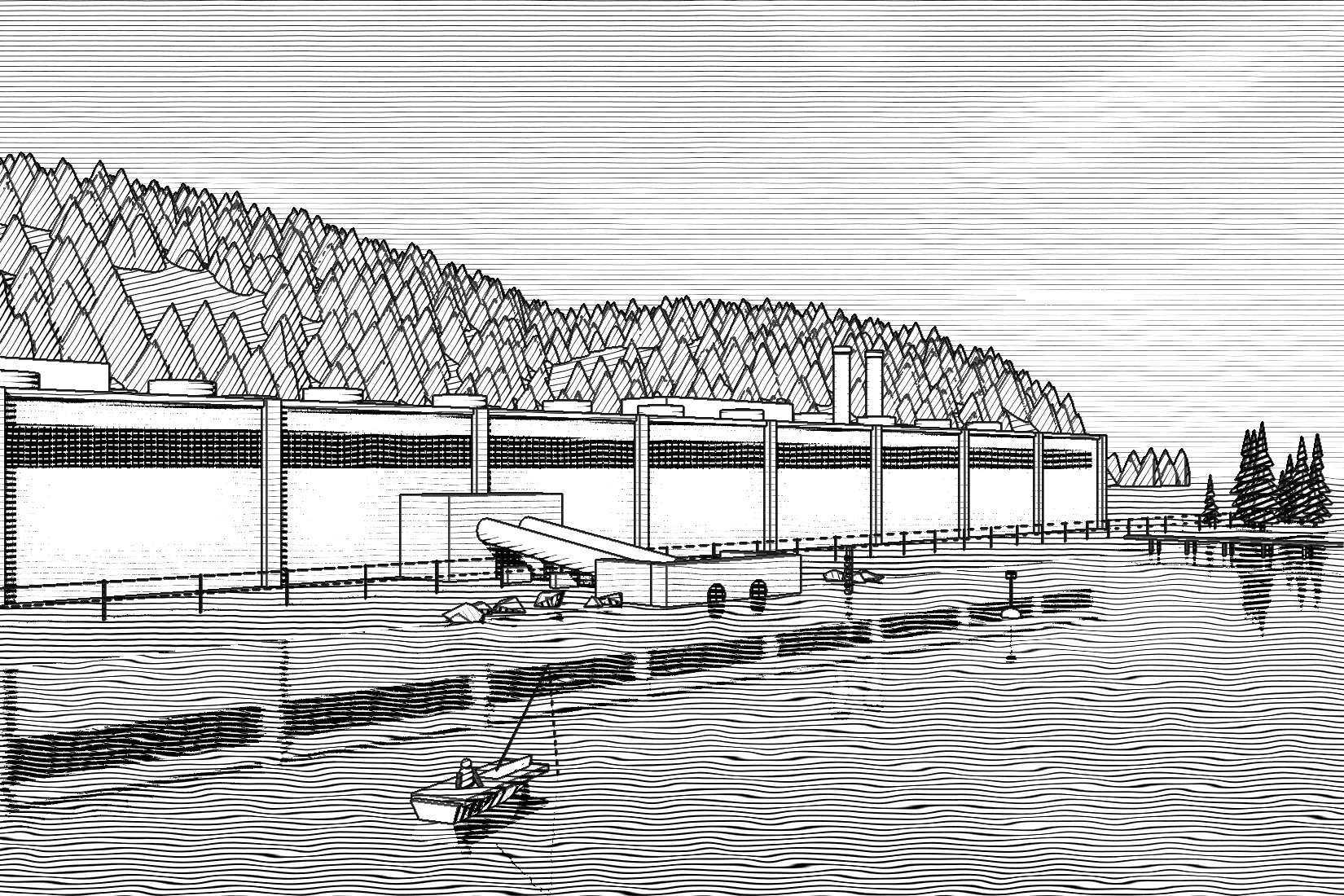
Hal Ostrander’s tractor spent six days at the edge of a potato field above Norhaven, waiting for someone with the right password. Engraving by Bram Keller
The message arrived at ten past four on a Tuesday afternoon, in the second week of the potato harvest, on a screen the size of a paperback mounted beside Hal Ostrander’s right knee. First came an amber triangle and a chime, polite as a doorbell. Then a line of capital letters: EXHAUST FLUID QUALITY FAULT. ENGINE POWER REDUCED. E-4127. SEE DEALER.
Ostrander, who is 58 and has farmed the same 260 hectares in the hills above Norhaven since his father handed him the keys in 1991, felt the tractor sag before he understood what the screen was telling him. Behind him, the harvester he was pulling through a field of seed potatoes began to labor. The web of steel bars that lifts the crop out of the soil slowed, and the two pickers on the sorting table—his nephew and a student from the town—looked up at the cab. “It went soft,” Ostrander told me. “Like somebody had a hand on the throttle and was easing it back.”
Nadia Rahman is a staff writer who covers repair, language, and machines—and, more often than not, the places where the three meet, from a stalled tractor to a weather model humming in a basement. She worked for six years as a court interpreter before moving into journalism, and she is finishing A Grammar of Broken Things, a book about the words mechanics invent for faults their manuals never name. She lives in Halbridge, carries a pocket multimeter in her coat, and has kept the office kettle alive for nine years past its warranty.
Payroll, pensions and the water bills of a small country still run on code older than the engineers maintaining it. Meet the night shift that keeps it alive.
He finished the row at walking pace. Fifty-two minutes later, as the light went orange over the ridge, the screen stopped being polite. ENGINE SPEED LIMITED. The engine settled at 800 revolutions a minute, enough to crawl home but not enough to drive the harvester, and stayed there. Ostrander climbed down, unlatched the side panel and stood looking at the engine for a while. “There was nothing to look at,” he said. “That’s the thing. In my dad’s day you’d look for the leak, or the smoke, or the bit hanging off. This was just a computer that had made up its mind.”
What it had made up its mind about, it turned out, was a sensor no bigger than a thumb, which samples the fluid the tractor sprays into its exhaust to break down pollutants. The sensor had failed and was reporting nonsense. A new one has a list price of 212 crowns. It is held on by two bolts and a plug. It took six days, two mechanics, 412 miles of driving, a password, a single bar of cell signal and roughly 29,000 crowns in damaged crop before Ostrander’s tractor would agree to use one. This is the story of those six days, and of a cable that a group of farmers built on a kitchen table so that the next six days might take an hour.
Fellside Farm, where 25 hectares of seed potatoes sat out a weekend of rain while the machine meant to lift them waited for a technician. Engraving by Bram Keller
Six days in September
Ostrander’s tractor is a 2019 Valdane 6240, a 240-horsepower machine he bought used in 2022 for 187,000 crowns and is still paying for. He likes it. It is quiet, it steers itself down the rows by satellite, and its cab is warmer than his kitchen. It also came with an operator’s manual that runs to 388 pages and tells him, in one form of words or another, to see his dealer 41 times.
The trouble is where the dealer is. When Ostrander took over the farm, there were three workshops within 30 miles that could service a tractor that size. The Valdane dealership in Norhaven closed in 2021, two years after it was bought by a regional dealer group, Stannard Machinery, which moved its northern servicing to a single site in Corran. The nearest workshop authorized to do software work on Ostrander’s tractor is now 206 miles south. Across the province, the number of dealer workshops licensed for that kind of work on the major tractor brands fell from 23 in 2010 to seven in 2025.*
So on Wednesday morning, Ostrander called Ray Cotter instead. Cotter, 64, spent 22 years as the lead technician at the Norhaven dealership and now runs an independent workshop out of what used to be its wash bay, which he rents from the man who bought the site. He arrived at the field at nine with a generic code reader, a box of tools and a flask of tea, and had the problem identified in 20 minutes. The sensor had failed internally. Everything else on the tractor was fine. He ordered a genuine replacement from Stannard’s parts counter, which sent it by overnight courier, and on Thursday afternoon he fitted it in a little under half an hour.
Then he turned the key. The screen thought about it and produced a new message: COMPONENT NOT RECOGNIZED. E-4190. SEE DEALER.
Every sensor on the tractor’s exhaust system carries a serial number, and the engine controller keeps a list of the serial numbers it expects to hear from. A new part, even a genuine one fresh from its sealed box, is a stranger until someone with the manufacturer’s software introduces it. The industry calls this component authentication. Repair advocates call it parts pairing, a term borrowed from the world of cracked phone screens. Whatever the name, the effect in a potato field was the same. The part was in, the tractor was idling, and the only person who could make the two of them speak to each other was 206 miles away.
“I can rebuild a gearbox blindfolded,” Cotter told me later, standing in the wash bay among the opened carcasses of three engines. “I can’t tell a computer that the sensor I just bolted on is the sensor I just bolted on.” He called Stannard that afternoon. The first available field visit was Monday.
The days in between were the kind farmers describe in weather. On Friday a neighbor, Aled Brisco, lent Ostrander a 1998 tractor with almost no electronics, which started first time and pulled the harvester across four hectares before the steep top of the field and the harvester’s hydraulic appetite defeated it. Brisco needed it back on Saturday for his own crop. On Saturday night, 36 millimeters of rain fell on Fellside Farm. Twenty-five hectares of seed potatoes sat in saturated ground, which is where seed potatoes begin to rot and bruise and fail the inspections that make them worth growing.
Ostrander spent the weekend doing what farmers do when they cannot farm. He called Stannard every morning to ask about cancellations, and by Saturday the woman on the service desk knew his voice. He checked the forecast on his phone, then on the radio, then on his phone again. On Sunday he walked the wet rows with a fork, lifting a plant here and there and breaking the tubers open with his thumbs to look for the first soft brown edge. “You can smell it before you see it,” he said. “Sweet, a bit like a cellar. I smelled it on Sunday.” The Valdane sat at the edge of the field with its engine off, looking, his wife, Gwen, said, “perfectly well.”
Joel Marchetti left Corran at five on Monday morning. He is 34, one of four field technicians covering the north for Stannard, and he spends most of each harvest in a van with a laptop, a diagnostic interface the size of a hardback book and a sleeping bag. He reached Fellside at 11:20. The dealer software had to reach the manufacturer’s servers before it would authorize anything, and the potato field had no signal, so Ostrander crawled the tractor at idle 400 meters up the track to the one gate on the farm where a phone shows a bar. Marchetti balanced his phone on the gatepost as a hotspot, plugged his laptop into the socket under the cab step and waited for a security code to arrive by text. The authorization took 14 minutes. Then he ran the engine through a 40-minute test cycle, wrote out the invoice and drove home.
Marchetti is not the villain of this story, and he is aware that he is often cast as one. “Half my job is driving, a quarter is plugging in, and the last quarter is apologizing,” he said. “I’m the most expensive USB cable in the north.” He agrees that almost everything he did at Fellside could have been done by Cotter, and says that if it were up to him, independent workshops would be able to buy the pairing software. It is not up to him.
Field call invoice, Fellside Farm
STANNARD MACHINERY · CORRAN SERVICE CENTER
Work order 25-09817 · Field call · Mon., Sept. 29, 2025
Customer: H. Ostrander, Fellside Farm, Norhaven
Unit: Valdane 6240 · Engine hours 4,812
Complaint: E-4190, component not recognized (customer-fitted sensor)
Travel, 412 mi @ 2.10 ........ 865.20
Labor, 3.5 hr @ 168.00 ........ 588.00
Component authorization fee ........ 95.00
Parts: supplied by customer ........ 0.00
TOTAL DUE ........ 1,548.20
Customer-supplied parts not covered by parts warranty. —J.M.
The invoice Joel Marchetti left on the Ostranders’ kitchen table. More than half of it is mileage. Courtesy of Hal Ostrander
Add it up, in crowns. The sensor: 212. Cotter’s two service calls: 180. Stannard’s invoice: 1,548.20, more than half of it for the drive. And the crop. When the last of the field was lifted the following week, 11 percent of it failed seed inspection and went for processing at a fraction of the price, a loss Ostrander’s grading slips put at 27,260.† His own accounting is shorter. “Something was broken for about a day. The rest was permission.”
Something was broken for about a day. The rest was permission.
— Hal Ostrander
His week was not unusual. When the Northern Growers’ Union surveyed its members after the 2025 harvest, 58 percent of those running a tractor or combine built after 2015 said they had waited three days or more for a dealer technician at least once that season, and one in five had waited a week or longer.‡ Most of the faults they described were electrical. Many, like Ostrander’s, were fixed in minutes once someone with the right login arrived.
The case for the lock
The manufacturers have answers to all this, and some of them are good. Corinne Ash is director of technical affairs at the Agricultural Machinery Manufacturers’ Council, the trade body for the companies that build most of the tractors and combines sold in the province. She met me in a glass-walled meeting room in Corran, under a framed cutaway drawing of an engine controller, and began with the exhaust. A diesel tractor must meet emissions limits for its whole working life, she pointed out, and if it doesn’t, it is the manufacturer, not the farmer, that answers for it.§
“A modern tractor is a network on wheels,” she said. “If anyone can tell the engine controller to trust a new component, then anyone can tell it to trust a component that doesn’t clean the exhaust, or a little box that only pretends to be a sensor. We know this happens. People sell those boxes.” Pairing, in her telling, is less a toll gate than the seal on a bottle of medicine. The same logic applies, she said, to steering and braking systems that are increasingly governed by software, and to the risk of someone reaching a whole fleet of machines through an unguarded port.
Ash also points out that owners are not entirely shut out. Since 2021, anyone with a Valdane machine has been able to subscribe, at 780 crowns a year, to a customer diagnostic tool that reads every fault code on the tractor and displays live readings from its sensors. Ostrander has heard this argument before. “It reads every code,” he said. “It just can’t do anything about them. It’s a thermometer. Lovely. Now I know I’m ill.”
The harder argument is commercial, and Ash made it carefully. Dealers make little on a new tractor and a good deal on keeping it running. A dealer network that is already thinning would thin faster, she argued, if its most profitable work could be done by anyone with a laptop, and that would leave fewer people trained for the problems no cable can solve: hydraulics, transmissions, a gearbox in pieces on a workshop floor. “You can be against the dealers,” she said. “But you might want them to exist when your transmission goes.” Cotter, when I repeated this to him, conceded the point and then gestured at the three engines in his wash bay. “I exist,” he said.
The argument has been rehearsed all year in the provincial assembly, where a repair bill would require manufacturers to sell owners and independent workshops the same manuals, diagnostic software and pairing functions they give their dealers, on what the draft calls “fair and reasonable terms.” At a committee hearing in March, farmers testified for two days about lost harvests and manufacturers about emissions and safety; a fire chief from the south of the province described a combine fire that had started, he said, with an owner’s badly made wiring repair. In June the bill went back to committee for redrafting, with members of every stripe saying they wanted a law that would let a farmer fit a sensor without letting anyone strip out an exhaust system. Nobody has yet written that sentence to everyone’s satisfaction.
A cable on a kitchen table
Some people decided not to wait for it. The Upland Machinery Cooperative began in 2019 as a way for farmers around Norhaven to share a few expensive implements—a stone separator, a slurry tanker, a hedge cutter nobody needed for more than three weeks a year. It now has 230 members, a rented grain store at the edge of town and, on a whiteboard above the kettle, a rule written in red capitals: WE FIX. WE DON’T DELETE.
The cable came out of a farmhouse kitchen six kilometers east of town. In the autumn of 2022, Linnea Dunmore, 41, a former agricultural engineer who now keeps 300 ewes, and Gil Tomasz, 71, who spent his working life maintaining telephone exchanges, set up an engine controller on Dunmore’s kitchen table. It had come out of a Valdane tractor of the same generation as Ostrander’s, which had burned in a barn fire, and the co-op had bought it at a salvage auction for 300 crowns. They wired it to a bench power supply, a set of sensors and a laptop, and for 14 months of evenings they listened.
“It’s a conversation,” Tomasz said. “Two boxes talking to each other hundreds of times a second. If you sit and listen long enough, you learn the language.” He filled nine notebooks with what he heard. Most of it was routine chatter: temperatures, pressures, the controller asking each sensor how it was and the sensor saying fine. What they were hunting for was the exchange that happens when a dealer’s laptop introduces a new part. They caught it in the spring of 2023, when a co-op member let them record everything that passed through his tractor’s diagnostic socket while a dealer technician replaced one of its sensors. It took them until February 2024 to understand what they had.
On tractors of that generation, the pairing turned out to be less a lock than a formality: a short sequence of messages telling the controller to forget one serial number and accept another. Nothing in it checked whether the new part was genuine, or whether it worked. Dunmore put it more simply. “The pairing doesn’t make the part work any better. It decides who is allowed to have fitted it.”
The pairing doesn’t make the part work any better. It decides who is allowed to have fitted it.
— Linnea Dunmore
The result is a grey cable with the tractor’s nine-pin diagnostic plug at one end, a USB plug at the other and a small circuit board in a printed plastic case halfway along. It runs a program the co-op wrote and called Hedgerow, which has three menus: read faults, show live data and relearn a replaced component. That is all it does. Dunmore and Tomasz deliberately left out anything that can write to the engine’s calibration, the settings that govern fuel, power and emissions. “If you want to delete your exhaust system, you’ll have to find somebody else,” Dunmore said. “And we’d rather you didn’t find them here.”
The co-op has made 140 cables. The lawyer who advises it, the niece of one of its founders, has told members that building the cable is lawful, that using it may void a warranty, and that the line they must never cross is the one written above the kettle. When I described Hedgerow to Ash, she was measured. She could not comment on a tool she had not tested, she said, and unauthorized software always carried risks an owner might not understand; but a tool that only relearned genuine parts would be “less of a concern than most of what we see.” By the standards of this argument, it was nearly a compliment.
The co-op’s cable fits the same socket as the dealer’s. What it is permitted to say once it is plugged in is the whole argument. Engraving by Bram Keller
Fifty-two minutes
Ostrander joined the co-op in January and bought a cable. For eight months it hung on a nail in his shed, between his father’s wrenches and a feed merchant’s calendar from 2009. “I felt like a man who’d bought a fire extinguisher,” he said. “You hope it’s decoration.”
On September 17 of this year, it stopped being decoration. Halfway through the first field of the harvest, the amber triangle came back, this time for a sensor that measures exhaust temperature. Ostrander plugged the cable into the socket under the cab step, balanced the laptop on the tread and read the fault himself. Then he called Cotter, who had the part on a shelf and was in the field 35 minutes later. The new sensor went on in 12 minutes, and the relearn took less than one. From the chime to the harvester turning again took 52 minutes. Cotter stayed another half hour to finish the tea in his flask, “because I’d brought it, and I wasn’t taking it home full.”
It would be pleasant to end there, and Ostrander would like to. But the kitchen table at Dunmore’s farmhouse has a new occupant. On tractors built from the 2025 model year onward, Valdane and at least two other manufacturers have moved to the kind of pairing Ash described: each new component must present a digital certificate that only the manufacturer’s servers can issue. Hedgerow cannot talk its way past that, and Dunmore does not think it should try. “That’s a real lock,” she said. “I’m not going to pick it. I want the assembly to make them sell us the key.” Tomasz, who is less patient, has bought another salvaged controller anyway. “I only want to hear what it says,” he told me. “Listening’s not a crime.”
The stakes run longer than one harvest. Ostrander’s father’s tractor is 52 years old and still starts on frosty mornings; the oldest machine in regular use among the co-op’s members is 61. A tractor sold this year with a certificate lock will, if it lives as long, still be working in the 2070s, by which time its maker may have changed its servers, its policies or its name. Several farmers I met had worked this out for themselves. One told me he had started looking at secondhand tractors built before 2010, “not because they’re better, but because they’re mine.”
Ostrander has no plans to sell the Valdane. He still likes it. But he has started doing something his father did, which is to keep a notebook in the cab: every fault, every part, every date, every bill. It is partly for the co-op, which is assembling a record of failures to put before the assembly when the bill comes back, and partly for himself. “I want to know what it costs to own it,” he said. “Not to buy it. To own it.”
When I left Fellside, the cable was back on its nail in the shed, coiled the way his father used to coil baler twine. Ostrander had hung it there himself. “That’s where tools go,” he said, and then, because he is a careful man and the bill is still in committee: “For now.”
Notes
*Figures from the Provincial Register of Agricultural Equipment Dealers, 2010 and 2025 editions, counting only workshops licensed by a manufacturer for software and warranty work on tractors above 150 horsepower from the province’s four best-selling brands. Stannard Machinery confirmed the 2021 closure of its Norhaven workshop and said its field technicians made more than 900 service calls in the northern counties during the 2025 harvest. ↩
†Ostrander’s grading slips from his seed merchant show 838 tons lifted from the field after the rain, of which 94 tons failed inspection for soft rot and bruising and were sold for processing at 45 crowns a ton rather than the contracted 335. The difference is 27,260 crowns. Ostrander accepts that some of that crop might have failed anyway; Cotter, who has seen a great many wet Septembers, thinks very little of it would have. ↩
‡The Northern Growers’ Union sent its post-harvest questionnaire to 1,140 members in November 2025; 377 replied, of whom 261 ran at least one tractor or combine built after 2015. The percentages in the text refer to those 261. The union supports the repair bill. It shared anonymized responses with The Margin, and its questions were drafted before the bill was introduced. ↩
§Interview with Corinne Ash in Corran, August 2026, and the Agricultural Machinery Manufacturers’ Council’s written submission to the assembly’s agriculture committee, March 2026. The council told The Margin that no member company has recorded a cyberattack on a farm machine in the province, and described its security concerns as preventive. ↩