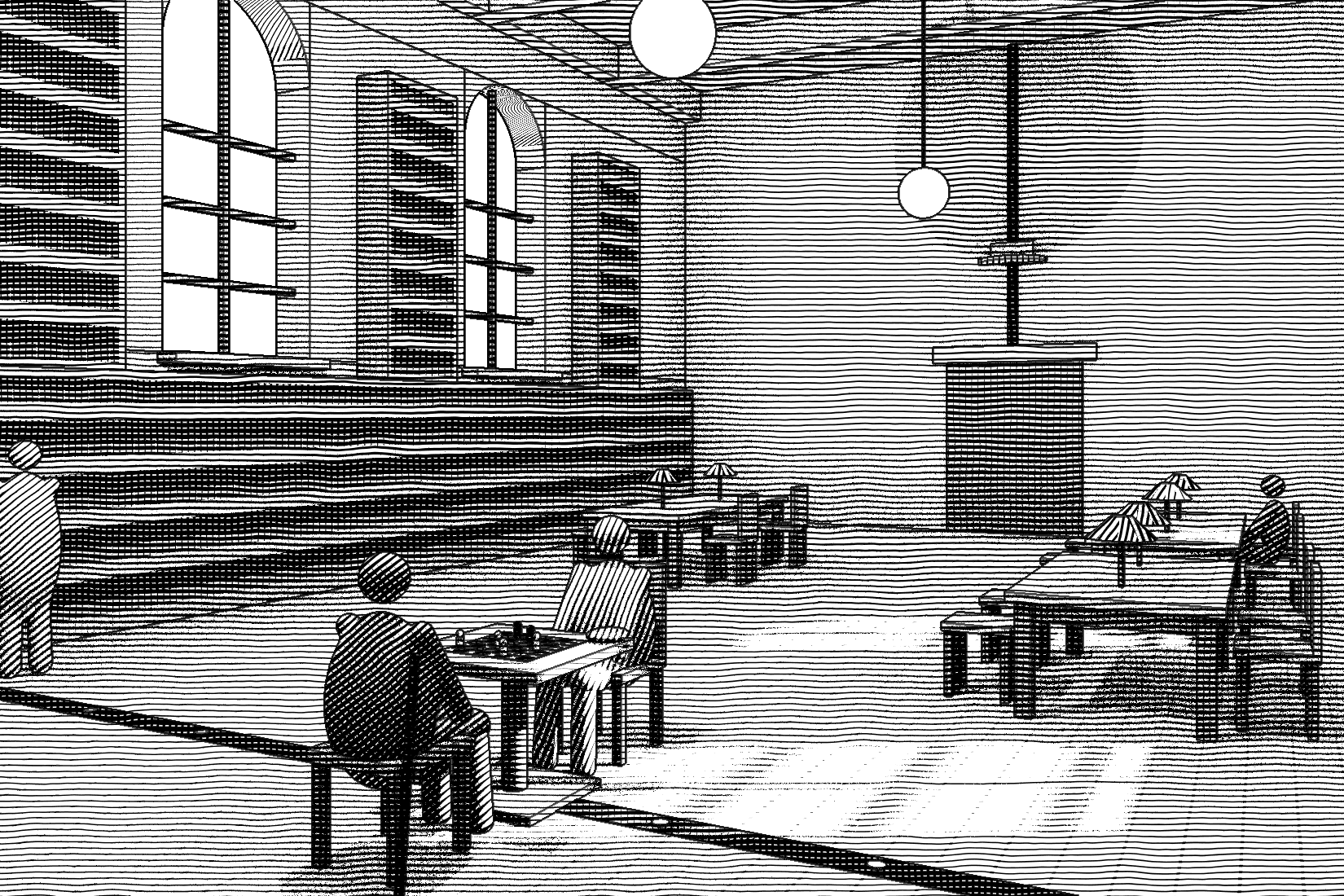
The long hall of the Drach Library, which opened across the boundary between Lannet and Ostrava Mill in April 1926. Engraving by Ivo Petrak
On Tuesday afternoons the chess table in the long hall of the Drach Library stands exactly on the border. A white line a hand’s width across runs beneath it, over the oak floorboards, under the circulation desk, and out through the far wall. Bohdan Lisk, 79, a retired loom mechanic, sits on the north side of the line, in Ostrava Mill. Arno Pell, 81, sits on the south side, in Lannet. Between them is a board with a cigarette burn on one corner, a relic of the years when smoking was permitted in the library on one side of the line and not on the other. They have played here most Tuesdays since 1983. Pell is ahead, by his count, by 41 games. Lisk disputes the count.
The library’s front door, under a stone portico, opens onto Market Street in Lannet. Its reading room, a double-height space with green-shaded lamps and some 40,000 books, lies entirely in Ostrava Mill. Getting from one to the other means passing from one country into another, which most visitors do several times an hour, usually carrying a newspaper, without giving it a thought. The library turned 100 in April. For almost all of that century it has been the simplest place in the region to sit down across a table from someone who lives on the other side.
Julien Moreau is the magazine’s cities correspondent, writing about housing, transit, and local government—the decisions made in council chambers that turn up years later as a bus route or an apartment block. He worked for six years as a route planner for the Halbridge Transit Authority, and his book Frequent Service is a sympathetic history of the timetable. He lives in Halbridge, does not own a car, and has ridden all 41 of the city’s bus routes from end to end, some of them twice by mistake.
A “fix it first” rule sounds like common sense. In three provincial districts it rewired local politics, and not always in the way its backers expected.
It was built that way on purpose. Anselm Drach, who owned the linen mill that gave Ostrava Mill its name, had his looms on one side of the boundary and most of his workers housed on the other, and in the 1920s the crossing between them meant papers and a long wait. When he left money for a library, his will specified a site “upon the line, so that no reader shall need a pass to reach a book.” Besides the portico, the building has a second, smaller entrance, the garden door, on the Ostrava Mill side. The two town councils took five years to agree on how to run it all. The result, the Joint Library Agreement of 1931, is 11 pages long and still in force.* It divides the running costs by floor area and sets out one rule for readers, which every regular can recite. Leave by the door you came in.
Leave by the door you came in.
The rule mattered most in the decades when the border was hard. Between 1949 and 1991, crossing Market Street meant a checkpoint, a stamp, and frequently a refusal. But Lannet residents could still walk in through the portico and Ostrava Mill residents through the garden door, and under the agreement no official on either side asked anyone anything once they were inside. Pell, it turns out, spent 26 of those years as a customs officer at the Market Street crossing, 200 meters from where he now sits. “All week I asked people for their papers,” he said, moving a knight. “Then on Tuesday I came here, and nobody asked for mine. I thought it was the most civilized room on the continent.” Lisk observed that this was the longest speech Pell had made in 43 years.
Two budgets, one roof
Liesel Kavan has been head librarian since 2009, which makes her the one person in the building who works for both towns at once. She is employed by the joint board that the agreement created, paid out of two municipal budgets that run on different fiscal calendars, and enrolled in two pension schemes, each of which, she says, treats her as roughly half a person. She answers to two fire inspectors applying two codes. The hall has two evacuation plans with two assembly points, a parking lot in Lannet and a churchyard in Ostrava Mill, and in a drill everyone leaves by whichever side of the building they happen to be standing in.
Most of the time the arrangement works because Kavan makes it work. Sometimes it doesn’t. The roof, a long slate pitch laid in 1926, straddles the boundary like everything else, and under the agreement each town maintains its own half. In 2024 a survey found both halves near the end of their lives. Ostrava Mill’s council paid for its share the following spring, and the north half of the roof is now pale new slate. Lannet’s council, facing a bill for a primary school roof in worse condition, deferred. Through the winter the south half leaked into the children’s room, which is in Lannet, and the staff set out seven buckets whenever rain was forecast. Kavan photographed every one of them and sent the pictures to both councils.
Emil Varos, who chairs Lannet’s finance committee, does not apologize for the delay, and his reasoning is hard to dismiss. “I had a school roof, a library roof, and one budget,” he told me. “Every child in that school lives in Lannet. Half the people under the library roof don’t. They don’t vote here, and they don’t pay Lannet’s taxes.” The figures bear him out. At the end of 2025, 51 percent of the library’s 3,912 active cardholders gave a Lannet address and 47 percent gave one in Ostrava Mill.†
What moved him was a petition. In January, a group of parents gathered 1,870 signatures asking Lannet to fix its half of the roof, and about 640 of them came from Ostrava Mill, from people who could neither vote for Varos nor against him. He found that more persuasive than he had expected. “It’s strange to be lobbied by people who aren’t your voters,” he said. “But they already pay for their half of the building, and they were asking me to look after mine. That isn’t freeloading. That’s a neighbor.” In March, Lannet approved the money. The scaffolding went up in May, on the south side only, and for the rest of the summer the library will wear a roof in two colors, which Kavan suggests is the most accurate map of the border anywhere in town.
The rules on either side
Inside, the border mostly takes the form of paperwork. Lannet lets children hold their own library cards at 12; Ostrava Mill makes them wait until 14. The circulation desk is three meters long and the line runs under the middle of it, so there are in effect two desks, and a 13-year-old from either town who asks for a card is issued one at the left-hand terminal, under Lannet’s rules. Kavan calls this “choosing the jurisdiction” and notes that neither council has ever asked her to stop. The library closes on both countries’ public holidays, 19 days a year. Fines were abolished in 2019, partly on principle and partly because collecting them in two currencies, with the day’s exchange rate chalked on a board beside the returns slot, had become a job in itself.
Then there were the 23 days in the spring of 2017, when a dispute between the two national governments over freight inspections closed the Market Street crossing to everyone except truck drivers. For the first time since 1991, the library’s two doors meant something again. The garden door, which in ordinary times is used mainly by the delivery van and by Lisk, was suddenly busy, and the old rule came quietly back into force. Families divided by a 200-meter stretch of road met in the long hall. A grandmother from Ostrava Mill held her grandson, born in Lannet two weeks earlier, for the first time beside the newspaper rack, standing on her side of the line while her daughter stood on hers. Kavan moved the newspapers. Visits that month were the highest in the library’s history.
It is tempting to turn the library into a parable, and the people who use it mostly decline to. To them it is where you read the paper, print a boarding pass, or take a toddler on a wet morning. But Kavan, who has spent 17 years administering two sets of rules under one roof, has come to think of a border less as a wall than as a system of accounts: a way of settling who pays for what, who is owed what, and who has to ask permission. “Most days it’s invisible,” she said. “You only see it when there’s a bill, or a leak, or a rule that’s different at one end of the desk. Then you have to decide what to do with it.”
At a little after four, Pell resigned. Lisk had his queen pinned, and both men had known it for several moves. They packed the pieces into a cookie tin that lives behind the desk. Then, out of a habit older than the open border, Pell left by the portico and Lisk by the garden door. I watched from the steps as they walked around opposite sides of the building, one along Market Street and the other beside the garden wall, and met again at the corner, where they set off together for the café, arguing about the count.
Notes
*Joint Library Agreement between the Municipality of Lannet and the Municipality of Ostrava Mill, signed in 1931 and amended in 1958 and 1992. Clause 4 apportions running costs by floor area: 54 percent to Ostrava Mill, which holds the reading room, the stacks, and the northern end of the long hall, and 46 percent to Lannet, which holds the portico, the children’s room, and the southern end. Clause 9 is the door rule. ↩
†Drach Library annual return to the joint board, 2025. The remaining 2 percent of cardholders live elsewhere. The door counter recorded 61,400 visits during the year, a figure Kavan regards as an undercount, since the counter sits at the portico and does not register anyone who comes in through the garden door. ↩