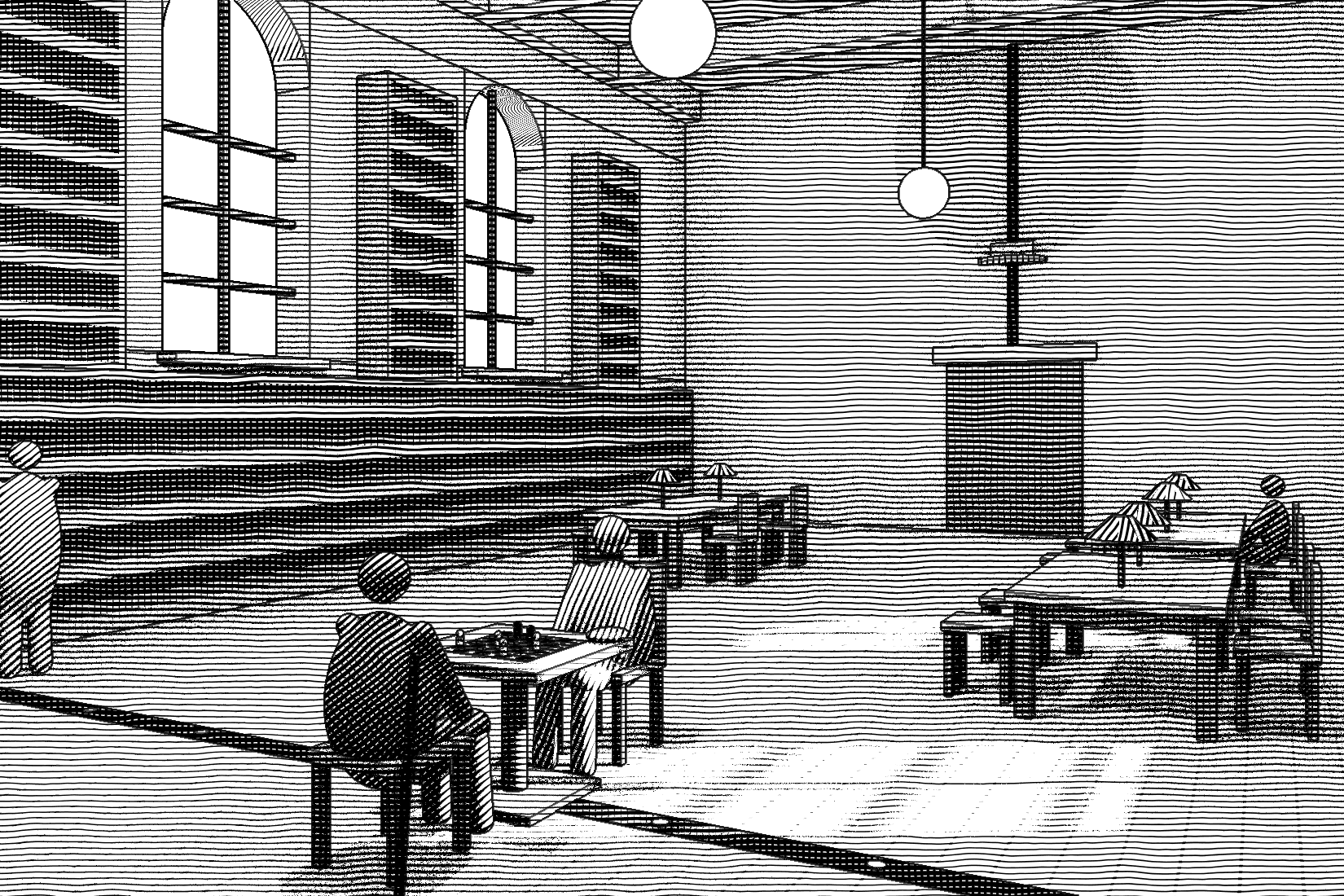
The Department of Public Works on Mason Street in Corran, where a top-floor control room watches the capital’s trunk mains through the night. Engraving by Ottilie Marsh
The budget hearing for the Department of Public Works began at 9:40 on a Tuesday morning last October, in Committee Room 4 of the National Assembly in Corran, and lasted 22 minutes. Three of the finance committee’s 11 members attended. Miriam Castell, the department’s director-general, had brought a 212-page annex describing the condition of every bridge, dam, culvert, and government building in the country. Nobody asked about it. The longest exchange concerned the department’s fleet of 412 vans, and whether it needed quite so many. I was the only reporter in the room.
Castell, who is 59 and a civil engineer by training, did not seem surprised. She put it to me in the corridor afterward, as a description rather than a complaint: “Our best year is the one nobody writes about.” The department she runs looks after 1,900 public buildings, 640 bridges on the national road network, 38 dams, the coastal flood barriers at Halbridge and Port Ellery, and the trunk mains that carry water from the upland reservoirs to the capital’s own utility.* When it does its job, nothing happens. It is very hard to campaign for nothing, and harder still to get it on the evening news.
Tiago Mendes is the magazine’s politics correspondent, covering public works, budgets, and the slow arithmetic of how roads, pipes, and bridges get paid for. Before journalism he spent eight years as a budget analyst in the Corran city treasury, and his book Line Items argues that a government’s real priorities live in its appendices. He lives in Corran, attends more public hearings than most council members, and keeps a borrowed hard hat on his coat rack in case anyone offers him a tour.
A “fix it first” rule sounds like common sense. In three provincial districts it rewired local politics, and not always in the way its backers expected.
For the past year the department let me sit in on its planning meetings, its night shifts, and its negotiations with the finance ministry. What I found was not a story of heroes and villains, though both sides of the assembly would like it to be one. It was a story about an institution whose successes are invisible and whose failures are spectacular, and about how everyone involved, the institution included, has learned to live with that arrangement.
The night of the main
At 3:12 a.m. on January 19, a section of the Ledwell trunk main—a steel pipe 1.4 meters across, laid in 1958—split along a weld beneath the Ostgate junction of the Corran ring road. Josefa Lund, the department’s duty engineer, was woken by the alarm at 3:14 and was on the phone to the control room by 3:16. By the time crews had isolated the section, at about 5:30, some 38 million liters of water had poured into the ground, 58,000 households were on low pressure or none, and a hole nine meters across had opened in the inside lane, into which a delivery van had settled, nose first.
The first camera crew arrived at 6:05. By the noon briefing there were more than 40 journalists at the cordon. By evening, both sides of the assembly had issued statements. The opposition bloc pointed out that in October the governing coalition had cut the department’s request for trunk-main renewal from 44 million crowns to 31 million. The governing coalition pointed out that the opposition, in its own four years in office, had cut the same line in two budgets out of four. Within two days the assembly passed an emergency appropriation of 48 million crowns to repair the main and inspect the rest of it—more than the entire renewal budget it had approved three months earlier.
Castell, to her credit and to the irritation of people on both sides, declined to say that the October cut had caused the burst, because it had not. On the department’s own priority list, the failed section ranked 38th; the missing 13 million would have gone to segments one through 12.† “The honest answer is that it didn’t fail because of October,” she said. “It failed because of every October. Because of 1985 and 1997 and 2009, and every year somebody decided it could wait one more year—and they were right, every time, until they weren’t.”
Both sides of the table
It would be easy to cast the finance committee as the villain here, and it would be wrong. Tomas Ferreira, the committee’s chair, who sits with the governing coalition, put the problem to me plainly in February. Every department that comes before him says its needs are urgent. The public works department’s needs are urgent in a way he cannot check. “They tell me that if I don’t pay, something will break,” he said. “Then something breaks anyway, and they tell me I should have paid more. I can never win that argument, and I can never verify it. Meanwhile the hospitals are in front of me with waiting lists, and the waiting lists have names on them.”
Nor has the department always made its own case easy. It overran the budget for the Halbridge ferry terminal by 40 percent in 2019. In 2023 it failed to spend 9 percent of its maintenance allocation, not for lack of work but for lack of people: 17 percent of its engineering posts are vacant, and private consultancies pay roughly a third more. A ministry that cannot spend what it has is in a weak position to ask for more, and its critics in the finance ministry say so, often.
Liesel Moravec, the opposition bloc’s spokeswoman on infrastructure, argues that the cure is to take the department’s core maintenance budget out of the annual fight altogether, with a five-year settlement tied to the measured condition of its assets. It is a serious idea, and the governing coalition’s objection to it is serious too: a five-year settlement is five years in which the assembly cannot move money to wherever the next crisis turns out to be. Moravec concedes that her side proposed no such thing while it held office. “We were in government,” she said. “Nobody volunteers to tie their own hands.”
Counting what didn’t happen
Lukas Ferrante, a budget officer who has worked at the department for 14 years, thinks part of the problem is bookkeeping. A failure produces a line in the accounts; a failure prevented produces nothing at all. So in 2025 he started what he calls the counterfactual register, a spreadsheet of every intervention that, in the judgment of the department’s engineers, averted something worse. A corroded bearing replaced on the Vennor viaduct in March. A spillway gate on the Askel dam repaired a month before the autumn rains. A cracked lintel over the entrance of a district courthouse, propped the day before a jury was due to walk beneath it. By December there were 112 entries, each with an engineer’s estimate of what the failure would have cost. The total came to 410 million crowns.
He presented the register at this year’s hearing, on September 22. This time, 10 of the committee’s 11 members attended, along with four reporters and a camera crew. The committee approved 52 million crowns for trunk-main renewal, more than the department had asked for a year earlier, and Ferreira asked that the register be attached to the annex from now on. Moravec’s multi-year settlement was sent to a working group, which both sides described as progress and neither expects to report before the next election.
Castell was pleased and not reassured. In her experience, she said, the memory of a burst main lasts about two budget cycles. By then the hole has been filled, the van has been towed, the lane has reopened, and the department is once again the place where money goes to produce nothing anyone can see. “I don’t want another January,” she said. “But I know exactly what happens if we don’t have one.”
On my last night with the department, in late September, I sat with Josefa Lund in the control room on the top floor of its building on Mason Street, where a wall of screens shows readings from 214 pressure points on the trunk network, each one a small green square. A pump at the Ledwell works cycled on at 1:40 and off at 2:15. A sensor in the northern suburbs flickered amber for four minutes, then settled. At six, Lund filled in the shift log, a ruled book that duty engineers have kept on that desk since 1961. Under incidents, she wrote the two words the department exists to write: none reported.
Notes
*Department of Public Works, Annual Asset Condition Annex 2025, and the national budget estimates for 2026. The department’s total budget this year is 2.1 billion crowns, about 1.3 percent of national spending. Its own estimate of deferred maintenance across all the assets it manages is 6.3 billion crowns, roughly three years of its entire budget. ↩
†Department of Public Works, Incident Review: Ledwell Trunk Main Failure, January 19, 2026, published in April. The review attributes the failure to corrosion at a field weld, accelerated by water from a leaking storm drain nearby, and identified three similar welds on the same main that were repaired in the following six weeks. ↩