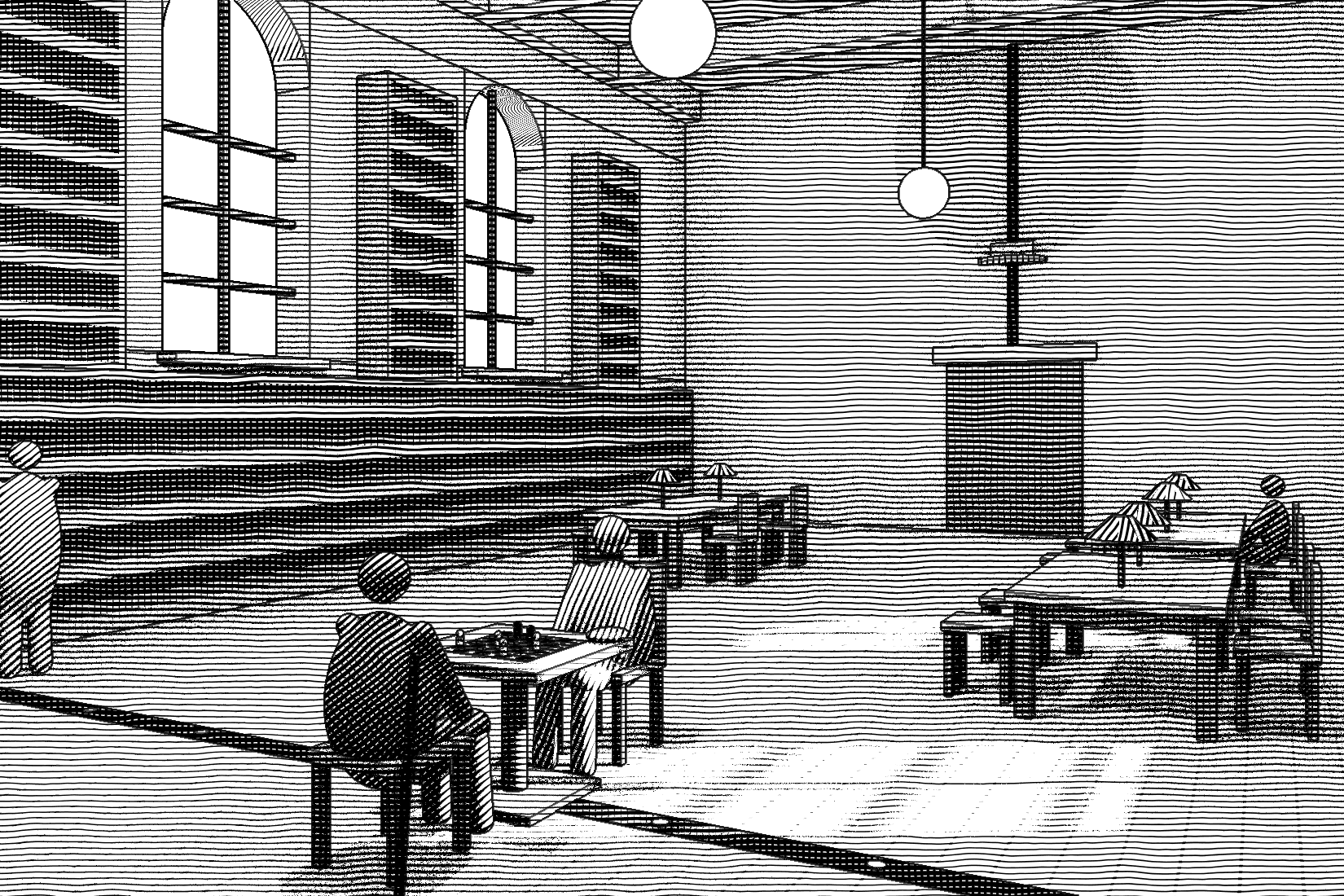
Houses along the No. 9 tram line in Halbridge, where Question 3 would allow buildings of up to six stories. Engraving by Ottilie Marsh
Marian Thorley keeps the 14 drafts in a green cardboard folder on her kitchen table, in order, each one shorter than the last. The first, written in January 2025, runs to 340 words and three subclauses. The last runs to 90. Between them lie a year of pencil crossings-out and, in every margin, a column of small figures where Thorley, a retired deputy city attorney who spent 28 years drafting Halbridge’s ordinances, counted the words on her fingers and wrote down the total. The city charter allows a ballot question no more than 100. “Everyone told me I had 10 words to spare,” she said. “It never felt like it.”
On October 20, the city’s 290,000 registered voters will be handed those words as Question 3. Here they are in full: “Shall the City of Halbridge allow homes up to six stories on lots within 800 meters of a rail or tram station, and up to four stories within 400 meters of a bus stop served every 15 minutes or better on the 2026 timetable, without a public hearing when a building meets the city’s design, safety, and heritage standards, provided one in eight homes in any building of 20 or more is rented below market for 30 years, and the city reports to voters on the results every five years?”
Julien Moreau is the magazine’s cities correspondent, writing about housing, transit, and local government—the decisions made in council chambers that turn up years later as a bus route or an apartment block. He worked for six years as a route planner for the Halbridge Transit Authority, and his book Frequent Service is a sympathetic history of the timetable. He lives in Halbridge, does not own a car, and has ridden all 41 of the city’s bus routes from end to end, some of them twice by mistake.
A “fix it first” rule sounds like common sense. In three provincial districts it rewired local politics, and not always in the way its backers expected.
It fits on a postcard, and the Yes campaign has printed it on one. What it would do takes longer to describe. If it passes, about 31 percent of Halbridge’s residential land would be rezoned overnight, and the planning department estimates that somewhere between 21,000 and 38,000 more homes would be built over the next three decades than would be built otherwise, on top of the roughly 1,150 a year the city manages now.* The range is wide, and the department says so. A zoning change is a permission, not a construction program. Whatever happened would happen one lot at a time, as owners chose to sell and builders decided the numbers worked, over a span longer than the career of anyone campaigning on either side.
The measure exists because rents in Halbridge have risen 41 percent since 2016 while median earnings have risen 19 percent,† and because the city council, which could have rezoned the same land by ordinance at any time, has debated doing so four times since 2018 without ever holding a vote. In 2024 a coalition of renters’ groups, builders, the staff associations at the city’s two hospitals, and an environmental group formed a campaign called Homes by the Line and decided to take the question to voters directly. They needed a lawyer who could write short. Somebody gave them Thorley’s number.
Every 15 minutes or better
Most of the 14 drafts are arguments about a single phrase. The early versions applied to land near “any bus stop,” which would have covered 91 percent of the city and, Thorley concluded, lost by 30 points. Adding a frequency test shrank the map to the places where transit actually comes often: two rail lines, three tram lines, and six bus routes. But a frequency test raised a harder question. Timetables change. If the transit authority added a frequent route in 2030, would the land along it be rezoned automatically? If it cut one, would buildings already approved become illegal?
In draft nine, Thorley let the map float with the timetable. In draft 11 she froze it. In draft 13 she let it float again, and in draft 14 she froze it for good with four words, “on the 2026 timetable,” adding the five-year report to voters as a release valve. Critics call the result zoning by bus schedule. The transit authority, which has taken no position, remarks that its timetables have never before been read so closely by lawyers. “A frozen map is wrong slowly,” Thorley said. “A floating map is wrong unpredictably. I chose slowly.”
Without a public hearing
If the measure has a fault line, it runs through the middle: “without a public hearing.” Under current rules, any residential building taller than three stories needs one, before the city’s planning commission, and the median such project waits 19 months between application and permit. Gwen Castellane, 64, a retired harbor pilot who lives in a brick terrace on Chandler Hill 300 meters from a tram stop, co-chairs the No campaign, which has named itself after the clause it objects to: Hear Us First. She does not describe herself as against new housing, and her front room, which looks down over the container port, is not the room of someone who wants the city to stand still. “I’ve spent my life watching this harbor change,” she said. “What I object to is being told the conversation is over before it’s started. A hearing is where a neighbor stands up and says, ‘You know there’s a spring under that lot.’ The planners don’t know that. We do.”
Her campaign keeps a list of such catches, the best known a 2019 apartment proposal on Tallow Street whose plans connected to a storm drain that, a neighbor pointed out at the hearing, had been filled in during the 1970s. Supporters of the measure keep a different list. Sefa Mensah, 31, a radiographer who shares an apartment above a laundromat on the No. 9 tram line with two roommates and spends 46 percent of her pay on rent, has been to one planning hearing in her life. It was at 2 p.m. on a Wednesday, and she took a day of leave to attend. “The people who can come to a hearing are the people who already live there,” she said. “Nobody ever testifies for the tenant who hasn’t moved in yet.”
Opposition does not come only from homeowners. Rafael Ibarra, an organizer with the Halbridge Tenants’ Assembly, which is also urging a no vote, believes the 90 words were spent in the wrong places. One below-market home in eight, he argues, is too few to matter, and rezoning land near stations will raise its price before a single building goes up, pushing out the tenants of the cheap older houses that stand on it now. “They’ve written a sentence for builders and put renters on the postcard,” he said. Thorley’s reply is that one in eight was the most the coalition’s financial modeling suggested a mid-sized building could carry and still get built, and that a higher figure would be a promise on paper and nothing on the ground. The two have debated this in public three times. They agree on nearly everything except the number.
Thirty years, lot by lot
What would the sentence do to an actual street? Kasia Dorn runs a family building firm with 11 employees, and since 2023 she has owned the site of a former tire shop on Rope Walk, 140 meters from a No. 9 stop. She has drawn a six-story building with 32 apartments and a bakery on the ground floor. Under current rules she would need a hearing, and her last project of comparable size took 26 months from application to permit, including an appeal she won. Under the measure, the city estimates, it would take about five. Four of the 32 apartments would be rented below market until 2059. If the vote goes her way, she would break ground in the spring of 2027 and hand over keys in 2029. If it doesn’t, she says, she will probably apply anyway, and wait.
Delphine Abara, Halbridge’s deputy planning director, is barred by city rules from taking a side and observes the rule scrupulously. She would, however, like people to stop picturing the cities the two campaigns describe. “The Yes side talks as though there’ll be cranes on every corner by Christmas, and the No side talks as though Chandler Hill will be bulldozed,” she said. “Neither is going to happen. Our modeling has about 1 percent of eligible lots redeveloping in a typical year. It’s a city changing at the speed of individual decisions. Someone retires, someone inherits, a tire shop closes.” In 30 years, she estimates, someone riding the No. 9 from end to end would see the difference. In three, they might not.
It’s a city changing at the speed of individual decisions.
— Delphine Abara
The most recent poll, taken in August by the Halbridge Civic Survey, found 46 percent in favor, 43 percent against, and 11 percent undecided, with renters backing the measure by roughly two to one and homeowners opposing it by a narrower margin. The Yes campaign has raised about three times as much money as the No campaign, much of it from builders and a regional employers’ association; the No side is funded mostly by small donations and four neighborhood associations. Each campaign accuses the other of describing a city that does not exist. In fairness, both are describing a city that does not exist yet.
The two campaigns, as it happens, are handing out the same 90 words. The Yes postcard prints them in full beneath a photograph of a tram. The No leaflet prints them in full too, with four of them underlined in red. Thorley keeps one of each on her refrigerator, side by side. “It’s the same sentence,” she said. “I’ve just never seen anything I wrote read so carefully.” She turns 72 the week of the vote. If Question 3 passes, the affordability terms on the first buildings it produces would expire when she is, by her own arithmetic, past 100; if it fails, the question goes back to a council that has so far declined to answer it. Either way, she said, that is the condition of writing law. You write one sentence, and a city spends 30 years finding out what it meant.
Notes
*Halbridge Planning Department, “Question 3: Capacity and Development Impact Analysis,” June 2026. The six-story band covers 14 percent of residential parcels and the four-story band a further 17 percent. The department’s theoretical capacity figure is 96,000 additional homes; its central estimate of 29,000 over 30 years assumes that about 1 percent of eligible lots redevelop each year, with low and high cases of 0.7 and 1.3 percent. ↩
†Halbridge Housing Observatory, annual rent survey, 2016–2025. The comparison is between the median asking rent for a two-bedroom apartment and median full-time earnings for workers living in the city. ↩