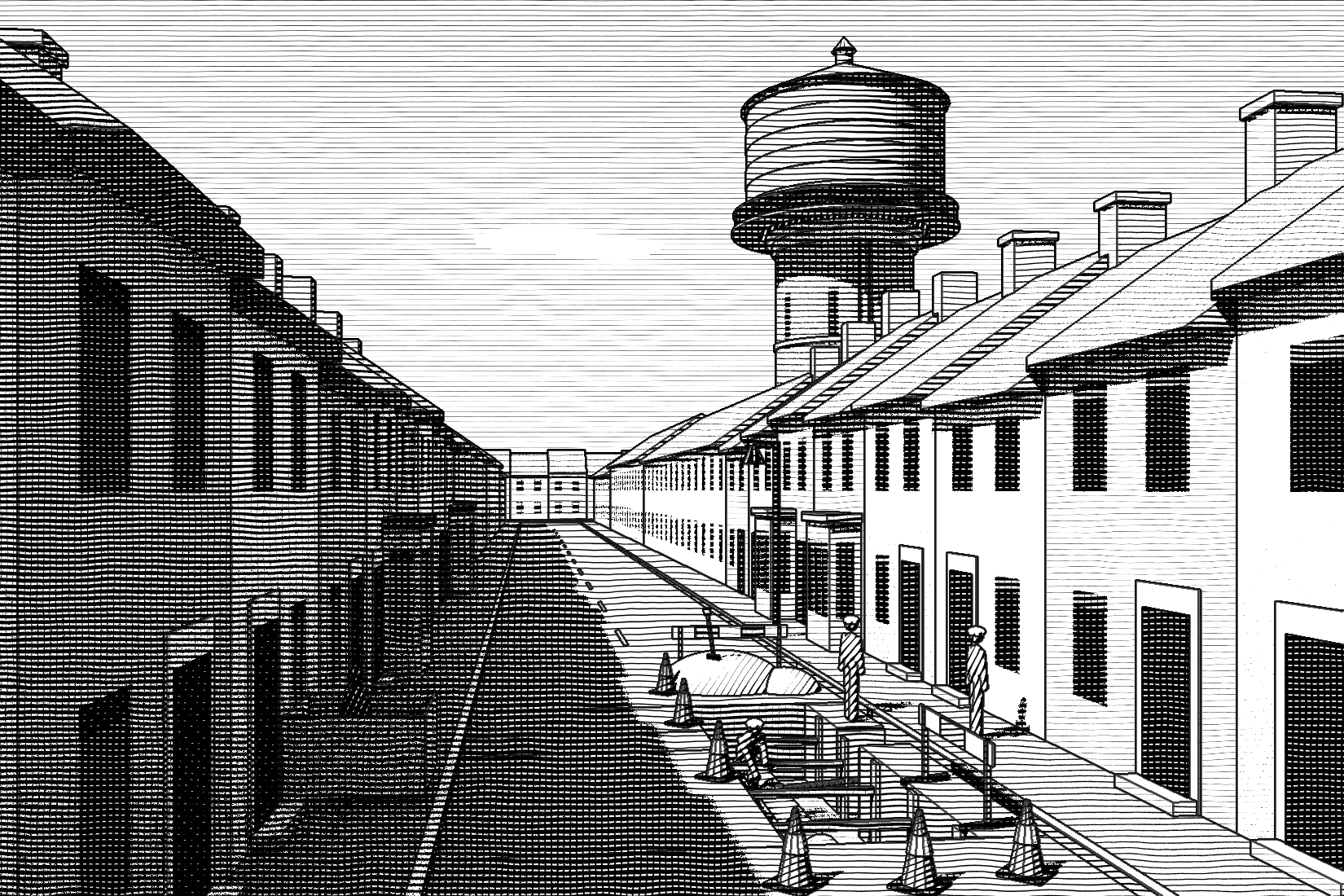
The Tanyard water tower in Corran, built in 1928 to serve the district’s new terraces. Most of the pipes beneath it were laid in the same decade. Engraving by Ivo Petrak
The letter is still on Amara Lisle’s fridge, held up by a magnet shaped like a tractor. It is dated June 2019, printed on the letterhead of Corran Water, the capital’s publicly owned utility, and its second paragraph says that “our records indicate that your property is served by a copper service pipe.” Lisle bought the house, a narrow brick terrace at 22 Linnet Street in the Tanyard district, two years later, and the letter came with the conveyancing papers. She remembers reading it with the particular satisfaction of a first-time buyer who has found one thing, at least, that she will never have to worry about.
In September 2024 a crew from the gas network came to move her meter and dug a trench across the front garden. Just before 11, the foreman knocked on the door and asked whether she knew she had lead. She showed him the letter. He showed her the pipe: dull gray, thick as a thumb, beaded with condensation in the cool of the trench, and bright as a new coin where he had scratched it with his key. “He was very kind about it,” Lisle said. “He said, ‘Somebody’s been telling you stories.’” Her son, Theo, was 18 months old. That evening she ordered a test kit. The utility’s own test, three weeks later, found 17 micrograms of lead per liter in the first water drawn from her kitchen tap in the morning. The national limit is 10.
Tiago Mendes is the magazine’s politics correspondent, covering public works, budgets, and the slow arithmetic of how roads, pipes, and bridges get paid for. Before journalism he spent eight years as a budget analyst in the Corran city treasury, and his book Line Items argues that a government’s real priorities live in its appendices. He lives in Corran, attends more public hearings than most council members, and keeps a borrowed hard hat on his coat rack in case anyone offers him a tour.
A “fix it first” rule sounds like common sense. In three provincial districts it rewired local politics, and not always in the way its backers expected.
Lisle was not unlucky. She was typical. Over the following 18 months, Corran Water discovered that its records of lead pipes—the records it had used to reassure 61,000 households, to plan its replacement program, and to report to the national drinking-water regulator—were wrong for roughly one older home in four. Its books listed 9,412 lead service lines. The real number, by the utility’s own central estimate, is about 24,300.* Replacing them will cost something like 150 million crowns, and the bill raises a question that, for most of the city’s history, nobody needed to ask: whose pipes are they? The answer, it turns out, also explains why the records were wrong.
The blank column
The waterworks clerks of the 1930s were meticulous about everything the city owned. The registers of service connections, kept in a basement room at the utility’s Tanyard depot, run to 64 volumes of ruled ledger paper, and each entry records the date a house was connected, the gang that did the work, the size of the main, the length and material of the pipe, and the pressure at which it was tested. The entry for 22 Linnet Street, in Book 14, is written in a clerk’s upright copperplate and dated March 14, 1931. It records 11 feet four inches of three-quarter-inch lead pipe running from the main to a stop-cock at the edge of the pavement. Then it stops.
No. 22 Linnet Street. Owner: H. Gilchrist & Son, builders.
Connected 14th March 1931. Gang No. 3, foreman W. Dabney.
Main: 6 in. cast iron (laid 1929). Tapped ¾ in., gun-metal ferrule.
Communication pipe: lead, ¾ in., 11 ft. 4 in. to boundary stop-cock.
Stop-cock in brick pit at footway edge. Tested 80 lbs. Sound.
Supply pipe: by owner’s plumber. Not inspected.
Footway flags relaid, two broken, charged to owner.
Entered J. M. Pryce, clerk. Checked R. T.
The entry for 22 Linnet Street, March 1931. The city recorded every inch of its own pipe and stopped at the stop-cock. Corran Water archive, Tanyard depot
The stop-cock was the boundary. Under the city’s waterworks bylaw, first passed in 1928 and amended only in detail since, Corran owns the main beneath the street and the short communication pipe that branches from it to the property line. Everything beyond the stop-cock—the supply pipe under the front garden, through the cellar wall, and up to the kitchen tap—belongs to whoever owns the house. In 1931 that pipe was laid by the builder’s plumber, almost always in lead, and the waterworks had no reason to inspect it and no column in which to record it. The city knew everything about the pipe it owned and nothing about the pipe it didn’t.
The line was drawn where it was for reasons that had nothing to do with health. Until 1919, Corran’s water came from a private firm, the Corran and District Waterworks Company, which had no wish to dig up its customers’ gardens or answer for their plumbers’ joints. When the city bought the company out, it kept the company’s boundary, along with its ledgers, its depots, and several of its foremen. The bylaw of 1928 wrote an old commercial convenience into municipal law. “It was a line between a supplier and a customer,” Vance said. “Nobody in 1928 imagined it would one day decide who pays to keep lead out of a toddler’s cup.”
For decades that hardly mattered, because both halves were lead. The trouble arrived in installments. Between the 1960s and the 1990s, whenever Corran renewed a main, it replaced the communication pipes along it in copper and left the owners’ side alone. At Linnet Street the renewal card is dated 1974. Then, in 1996, the utility hired a contractor to turn the ledgers and renewal cards into its first computer database. The database had a single field for the material of each connection, and the contractor’s data-entry manual—which Teodora Vance, the utility’s head of network records, found in a box file in 2023—instructed clerks that where a renewal card existed, they should enter the material shown on the card. A house with 1974 copper on the city’s side and 1931 lead on the owner’s became, in the city’s records, a copper house. It stayed one for 28 years: through a national notification campaign, three internal asset audits, and the sale of 22 Linnet Street to a primary-school teacher in 2021.
“We wrote down what we owned and guessed at what we didn’t, and we put both answers in the same box,” Vance said. She is 48, a hydrologist by training, and speaks about databases the way some people speak about their in-laws: with weary affection and no illusions. “Nobody lied. Every step was reasonable on the day it was taken. That’s what makes it so hard to explain to someone like Amara. She asks who did this to her, and the most honest answer I can give her is a field width.”
Digging to find out
Vance had suspected for years that the database was optimistic. Crews renewing mains kept reporting lead where the records said copper, and she kept a list of their reports in a spreadsheet she titled, with some restraint, Discrepancies. By the autumn of 2024 it had 214 entries. When Lisle’s case reached the local evening news that November, the utility’s board agreed to pay for what Vance had been requesting since 2022: a statistically designed sample of 1,600 properties, drawn at random from the 61,000 connections built before 1960, at each of which a crew would dig a small pit on both sides of the boundary and look.
The digging ran from February to October 2025, and the results, published in January, were worse than she had feared. Crews found lead on at least one side of the boundary at 637 of the 1,600 properties. The records had listed 246 of them. At the other 391, the database said copper, galvanized steel, or unknown, and the pit found lead—almost always on the private side, almost always beyond a stop-cock where the city’s own pipe had been renewed decades earlier. Extrapolated across the city, the sample implies about 24,300 lead service lines, two and a half times the official count. The missing ones are concentrated in three places: the terraces of Tanyard, the steep 19th-century streets of Ashlar Hill, and the interwar municipal estates of Northgate.
I watched one of the last pits being dug, in October, outside a pebble-dashed semi in Northgate. The crew—three men, a van, a compressor, and a surveyor with a tablet—cut a square of pavement half a meter across, dug the last 30 centimeters by hand, and found, at a depth of 70 centimeters, copper. They moved two meters into the front garden, with the owner’s permission and a good deal of his advice, and dug again. Lead. The surveyor photographed it beside a yellow scale bar, scratched it with a key, and logged it as record 1,571. The owner, a retired bus driver named Stellan Mork, had lived in the house for 41 years. He looked into the hole for a long moment. “Forty-one years,” he said. “I’ve been making tea with that.”
The digging forced a second, more uncomfortable reckoning. For years, when Corran Water found lead on its own side of a connection, its policy had been to replace its own side, join the new copper to whatever the owner had, and move on. In the spring of 2025, the utility’s water-quality unit tested 60 homes where this had been done. In 41 of them, lead levels spiked in the weeks after the work, in some cases to more than 10 times the limit.† Cutting and rejoining an old lead pipe shakes loose the mineral crust that lines it, and joining lead to copper sets up a small electrical current that corrodes the lead faster. In May 2025, Corran Water stopped doing partial replacements altogether.
“That was the moment ownership stopped being an accounting question,” Vance said. “You can’t fix half a pipe. Physically, chemically, you cannot do it safely. The legal line runs through the middle of the stop-cock, and the water doesn’t know it’s there.” She suspects that the gas crew’s trench, which shifted Lisle’s pipe by a few centimeters, may itself have pushed her reading over the limit. Lisle has thought about that more than she would like. “So the lead was fine until somebody found it,” she said. “That’s a comforting sentence for about a second.”
The legal line runs through the middle of the stop-cock, and the water doesn’t know it’s there.
— Teodora Vance
Verification pits in Northgate in the spring of 2025. Crews dug on both sides of the boundary at 1,600 properties across the city. Engraving by Sunniva Holt
The bill comes due
Lead is only the sharpest edge of a much larger bill. Like most cities its age, Corran laid the bulk of its water network in two great bursts: the interwar building boom that produced Tanyard and Northgate, and the postwar decades of estates and new suburbs on the city’s edge. Corran Water now values the whole network at 1.82 billion crowns, and 59 percent of that value lies in pipes laid between 1920 and 1969, nearly all of which are approaching or past the end of their design life. At the utility’s current rate of capital spending, about 88 million crowns a year, replacing everything would take more than two decades, even if nothing else needed doing.
Corran’s replacement bill, by decade laid
Estimated cost of replacing the city’s water mains and service connections, grouped by the decade in which they were installed. Pipes laid between 1920 and 1969 account for 59 percent of the 1.82 billion crown total. Source: Corran Water asset register, 2025 valuation
The bill is arriving all at once because it was deferred all at once. Through the 1990s and 2000s, Corran renewed its mains at about 0.6 percent a year, a pace that implies replacing each pipe roughly every 160 years, against a design life of 80 to 100. Rates stayed low, which every council of the period counted as an achievement, and the pipes kept working until, increasingly, they didn’t: bursts on the city’s mains rose from about 300 a year in 2005 to 520 last year. Not even the national government’s pipes are exempt: in January a trunk main beneath the ring road split along a 1958 weld and left 58,000 Corran households on low pressure for most of a day.
The mains, at least, are unambiguously public. They will be paid for, as they always have been, from water rates, slowly, with arguments about the pace. The lead service lines are different, because about two-thirds of their cost lies on the owner’s side of the boundary. Vance’s team puts the average full replacement at 6,200 crowns: about 2,100 for the city’s portion and 4,100 for the owner’s. Averages conceal a great deal. A short run under a front garden can be done for 2,800. A pipe that runs beneath a tiled hall, a conservatory, or a shared passage can cost three times that, and in the oldest streets of Ashlar Hill, where some houses are fed by a single lead pipe that branches beneath a neighbor’s cellar, nobody is entirely sure whose pipe is whose.
Lisle’s pipe runs under her hallway, beneath encaustic tiles laid in 1931 that she spent a summer restoring on her knees. The cheapest quote she received for her side was 6,800 crowns, about six weeks of her take-home pay. She has not had the work done. Like thousands of her neighbors, she is waiting to see what the council decides, because whatever it decides is unlikely to refund anyone who paid in advance.
The last meter
The decision belongs to Corran City Council, whose infrastructure committee published three options in February and will put one of them to the full council in May.‡ The first leaves ownership where it is: owners pay for their side, and the city offers low-interest loans to anyone who asks. The second treats the whole pipe as a public-health asset and pays for all of it from water rates, adding about 67 crowns a year to every household’s bill for a decade—a little over 10 percent on the average bill. The third, which the committee’s chair is backing, sits between them, and it is where the argument has settled.
The case for paying in full from the rates is made most forcefully by Aurelio Dunn, an opposition bloc councilor who represents Northgate, where 63 percent of the homes in the sample were rented. It rests on three points. The first is that the city told 61,000 households what was in their walls, and for nearly all of them it was guessing about the half that mattered; an institution that gives false assurance, he argues, owes more than a loan. The second is that lead harms whoever drinks the water, not whoever holds the deeds, and voluntary schemes leave behind exactly the people least able to act. Corran Water’s own pilot in Northgate last year offered owners half the cost of their side; 31 percent of owner-occupiers signed up, and 12 percent of landlords. The third is chemistry. If half a pipe cannot be safely replaced, the city cannot finish its own work without touching the owner’s. “Property law is a fine way to decide who mends a fence,” Dunn said. “It is a terrible way to decide which children get lead in their water.”
The case on the other side is made by Ines Corvo, the committee’s chair, who sits with the governing coalition and is not, she says, opposed to spending money, only to spending it without looking. Lead lines are concentrated in Corran’s oldest housing, and some of its oldest housing is now its most expensive: the median house on Linnet Street sold last year for more than 600,000 crowns, and the townhouses of Ashlar Hill for twice that. Paying for every private pipe from the rates would mean the tenant of a flat built on the docks in 2015, with no lead and a modest income, helping to pay for an improvement to a house worth seven figures—an improvement that, according to estate agents in Tanyard, is already starting to show up in asking prices. “A roof belongs to the house. So does a boiler. So does this,” Corvo said. “If the rates pay for the owner’s pipe, somebody needs to explain to me why they don’t pay for the owner’s wiring.”
Her compromise runs as follows. The city would replace both sides of every lead line, street by street, in a single dig, whether or not the owner had asked, ending both the partial replacements that the chemistry forbids and the low uptake that the pilot exposed. It would pay for its own side outright. The cost of the owner’s side would become a charge on the property, interest-free, repayable over 20 years or on sale. The charge would be waived for households below an income threshold and, in what Corvo calls a matter of honor, for every property where the city’s records had said the pipe was not lead.
Dunn calls it the best option on the table and still not good enough, and his objection is precise. The honor waiver covers homes recorded as copper or galvanized steel. It does not cover the 123 homes in the sample, and by extrapolation about 4,700 across the city, where the database said unknown. “We wrote unknown because we never looked,” he said. “Now unknown means you pay.” Corvo’s answer is that an unknown told nobody they were safe, and that a line has to be drawn somewhere. Both of them have a point, which is roughly why the vote has already been postponed twice.
Lisle has watched every committee session, from the public gallery or, when Theo is ill, on the council’s video stream. Under Corvo’s plan her letter would qualify her for the waiver, and she says so with some discomfort. “I’m the sympathetic case,” she said. “I had the letter. But two doors down, at number 26, the record said unknown, and they’ve got lead too, and three kids. Why am I more deserving than them? Because the city wrote something wrong about me instead of writing nothing?”
Not inspected
In the meantime, she has organized her street. Fourteen of the 19 houses on Linnet Street have lead on the private side, and in January their owners agreed that if the council has not decided by summer, they will hire one contractor to do all 14 in a single fortnight and argue about refunds afterward. The joint quote came in at 3,900 crowns a house, a little over half what Lisle had been quoted alone. The residents keep their correspondence in a group chat whose name Lisle declines to take responsibility for.
The owner’s side of the line: a supply pipe entering a Tanyard cellar, where most of the lead the city never recorded is found. Engraving by Ottilie Marsh
Every morning, before she makes Theo’s breakfast, she runs the cold tap in the kitchen for two minutes into a bucket for the garden, which flushes out the water that has sat overnight in the lead. She has done it more than 500 times. The filter jug lives on the counter beside the kettle. Down in the cellar, where the gray pipe comes through the brick beside a brass valve, she has tied a paper tag to it with string. It says LEAD in marker pen and, underneath, in smaller letters, the date the gas crew found it.
In Book 14 of the waterworks registers, the line about her pipe is the shortest on the page. Supply pipe: by owner’s plumber. Not inspected. For 95 years those seven words were the whole of the city’s knowledge about the pipe her son drinks through, and the whole of its theory about who was responsible for it. In May, the council will decide whether to rewrite either.
Notes
*Corran Water, Service Line Verification Program: Final Report, January 2026. The 1,600 properties were drawn at random from the 61,000 connections built before 1960, stratified by ward and by decade of construction. The central estimate of 24,300 lead service lines has a 95 percent confidence interval of 21,800 to 26,900. Of the 391 lead lines the database had missed, it had recorded 268 as copper or galvanized steel and 123 as unknown. ↩
†Corran Water Quality Unit, Lead Release Following Partial Service Line Replacement, internal memorandum, April 2025. Of 60 homes sampled weekly for 30 days after a partial replacement, 41 exceeded the 10-microgram limit in at least one sample. The median peak was 23 micrograms per liter; the highest was 140. In most homes, levels returned below the limit within three months. ↩
‡Corran City Council Infrastructure Committee, Options for the Replacement of Lead Service Lines, February 2026. The rates figure assumes the owners’ share of about 100 million crowns is spread across 148,000 household bills over 10 years, before borrowing costs; the average annual water bill in Corran is 640 crowns. The committee estimates that the waiver for misrecorded properties would cover about 42 percent of homes with lead lines, and the income waiver a further 14 percent. ↩