The Varne Picture House in Little Varne reopened in October 2024 after 41 years dark. Every one of its seats has a sponsor. Engraving by Ivo Petrak
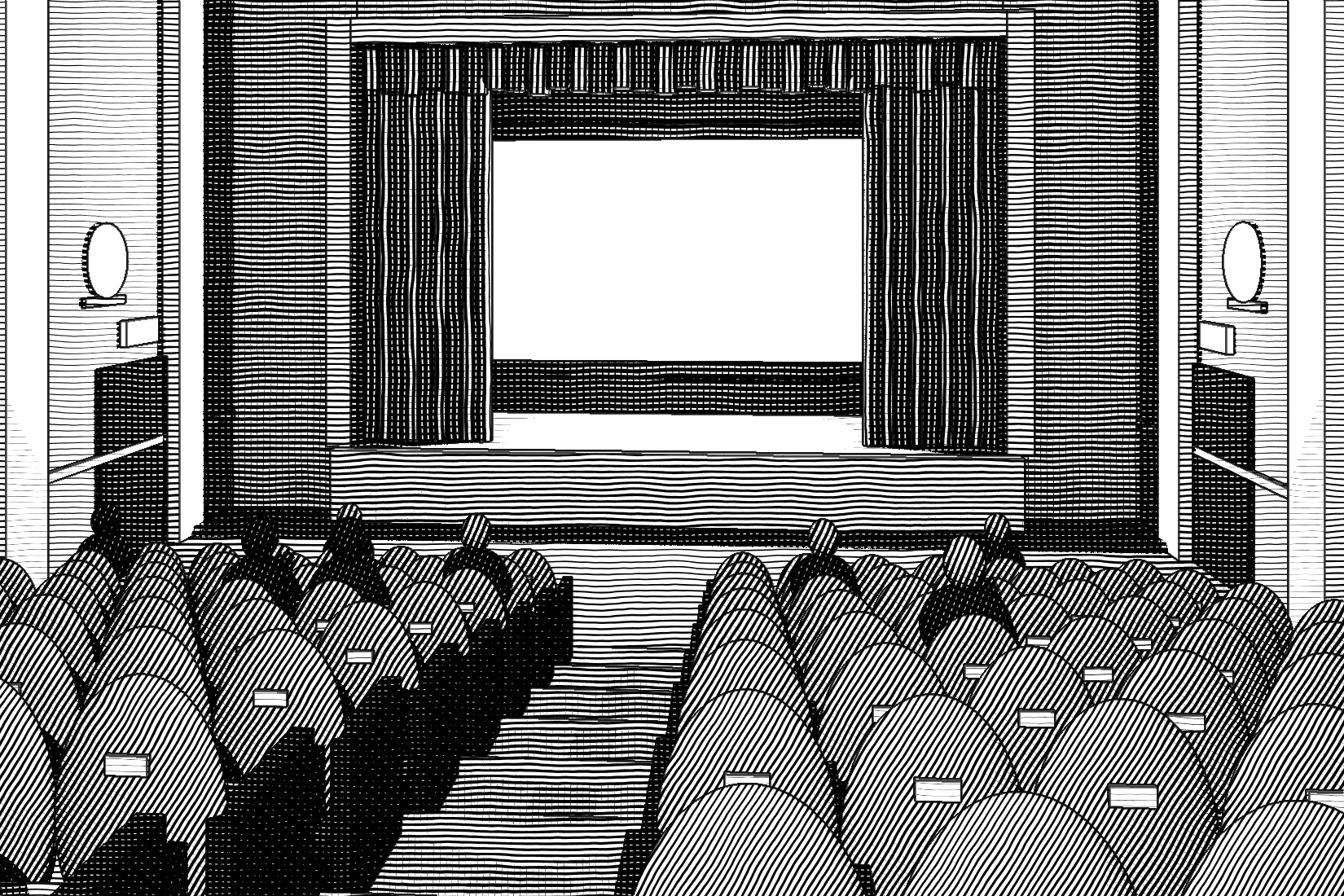
At ten past seven on a Friday evening in March, the foyer of the Varne Picture House smells of wet wool and coffee, and most of Little Varne is looking for its own name. It is not hard to find. Each of the cinema’s 112 seats carries a small brass plate on the top of its backrest, and on the plates are names: THE FERRIS TWINS (NO SWAPPING). GORDON PYE, WHO WILL TELL YOU ABOUT THE STARS. BISCUIT, A GOOD BOY. IN MEMORY OF NAN, WHO TALKED THROUGH EVERYTHING. Most of the names belong to people who are, at that moment, edging along a row with a tub of ice cream, saying sorry, sorry, sorry, and sitting down in their own seats.
There is no rule that you must sit in your own seat. The trust that runs the cinema was firm about this at the start, and the village has politely ignored it ever since. A seating plan has emerged that nobody drew: families in the middle rows, teenagers at the back, children at the front under plates their grandparents paid for, and the parish council together in row H, where it can be heard but not seen. “If someone’s in your seat when you arrive, they move,” says Gwen Tarrow, who chairs the committee that chooses the films. “Nobody wrote that down. Nobody needed to.” On an ordinary Friday, 74 people come. That is about one in every 12 people who live here.
Ruth Hollis is a senior writer who covers work, craft, and the small places that larger stories tend to skip—village bakeries, repair cafés, lighthouse towers, and a cinema rebuilt one seat at a time. She spent seven years as a deckhand on the Port Ellery ferry before turning to journalism, and her first book, Open Until Six, followed a year in the lives of 12 coastal shopkeepers. She still lives in Port Ellery, takes notes in a shorthand nobody else can read, and always buys something from the people she interviews.
The mill closed, the bank left and the post office became a flat. On Saturday mornings, a folding table in the old library still fixes about forty things.
Every month, eighteen singers travel to a deconsecrated building and record its echo before it becomes flats, a climbing gym or nothing.
Funmi Adeyemi·7 min read
This article is free to read. You have 3 of 3 free articles left this month.Subscribe
Seat by seat
The Picture House was built in 1931 by a garage owner who had seen a talking picture in Halbridge and decided Little Varne should have one too. It ran for 52 years. The last show was on a Saturday in March 1983, after which the building became a farm-supplies store, then a store for nothing in particular, and then, after the winter of 2016 took a third of its roof, a hazard. When a newly formed community trust bought it from the farmer who owned it, in 2019, for a sum both sides describe as nominal, there were ferns growing in the projection box and nothing at all on the auditorium floor. The original seats had gone for scrap in 1984.
The trust needed about 640,000 crowns. A rural buildings fund would supply most of it, on condition that the village raise a fifth itself and show that the cinema would be used. A fifth was 128,000 crowns, or about 142 for every man, woman and child in Little Varne, a good many of whom were pensioners and some of whom were babies. The trust’s treasurer, a retired bank manager named Alan Brisco, considered the problem for several weeks and arrived at a principle. “Nobody wants to sponsor a roof. You can’t sit in a roof. You can’t put your grandchild’s name on a roof. Well, you can, but nobody sees it.”
Nobody wants to sponsor a roof. You can’t sit in a roof.
— Alan Brisco
So the trust sold chairs. In the autumn of 2019 it bought 112 secondhand seats from the Coliseum in Asterby, a mill-town cinema closed since 2011, for the price of a hired van and a weekend. Each needed its frame blasted and repainted, its springs replaced and its velvet renewed. The trust offered them to the village at 750 crowns apiece, brass plate included, engraved with whatever you liked within reason. Those who couldn’t find 750 crowns at once could pay 15 a week for 50 weeks across the counter at Aske’s bakery, where Wyn Aske kept the installment book beside the till. Eighty seats went in nine days. The last, number 112, sold in the 11th week, to a buyer who asked to stay anonymous and for the plate to read RESERVED FOR WHOEVER NEEDS IT.
Then Alan started selling armrests. There are 124 of them, at 150 crowns each, and they went in a month. After that he sold the 40 pleats of the new stage curtain, the 31 steps up to the projection box and, in what the committee still describes as a low moment, the light bulbs in the foyer. By the spring of 2021 the village had raised 131,000 crowns, a little more than it needed, from 412 separate buyers, close to one for every household in Little Varne.* The fund paid out. Volunteers did much of the rest, logging some 14,000 hours over five years, and the Picture House reopened on Friday, October 4, 2024.
The man in the box
Up those 31 sponsored steps, in a box with two portholes, sits Bernard Quill, who is 79 and has shown films in this building twice. The first time began in 1961, when he was 15 and the rewind boy; by 1970 he was chief projectionist, and in March 1983 he ran the last show, a comedy called The Ferryman’s Wedding, to an audience of 46. After the closure he repaired televisions for two years, then spent 27 in the projection box of a cinema in Halbridge, until it went digital in 2012 and no longer needed him. He was the first person the trust called.
The Picture House runs a digital projector, as every cinema must now, and Bernard tolerates it. “It’s fine,” he says. “It doesn’t need me. That’s what’s wrong with it.” What he loves are the two 1950s 35mm projectors he found in a barn outside Westmere and rebuilt over two winters at his kitchen table, and which he runs on the first Friday of every month, when the committee chooses something old enough to exist on film. Then he is busy in the way he remembers: threading, checking the loop, watching for the cue dots that flicker in the corner of the frame to tell him to switch from one machine to the other, every 20 minutes, without the audience noticing a thing.
On October 4, 2024, he reopened the Picture House with The Ferryman’s Wedding, from a print he had tracked down in an archive in Corran. Twenty minutes into the third reel there is a scratch, a thin white line down the right of the frame that lasts about four seconds. Bernard says it was there in 1983. He is fairly sure it is the same print. Nobody has been able to prove otherwise, and nobody has tried very hard.
Friday
The films are chosen by a committee of six, from suggestions anyone may drop into a ballot box in the foyer, and its deliberations are, by every account, fierce. It alternates new releases with older films and shows something for children at six o’clock on the first Friday of the month, before Bernard’s 35mm. The most requested film in 17 months of ballots is a musical from the 1950s, which has now been shown three times. The least successful screening, a three-hour drama about a shipping dispute, drew 19 people, 12 of whom, Gwen says, were on the committee or married to someone who was, and felt responsible.
The money still has to work every week, and it is tight. Tickets are eight crowns, or five for children, and the distributors take between 35 and 50 percent of every one. What keeps the Picture House solvent is the counter in the foyer, where an ice cream that costs the trust less than a crown sells for three, and the hire of the hall on nights without films: a yoga class, the brass band, a wedding reception that ended, Alan says, with an incident involving the curtain that he would rather not go into. Last year the cinema made a surplus of 4,180 crowns. Bernard and every other volunteer are unpaid. “We’re a business that only works because nobody gets paid,” Alan says. “Which I believe makes us a village.”
About 70 of the 112 plates name people who are alive and living in Little Varne, and on most Fridays most of them are here. Seat F7 is an exception. So, now, are the seats of the five plate-holders who have died since the reopening. The trust discussed what to do about those seats and decided, after a short meeting, to do nothing at all. “An empty seat is a waste of a seat,” Gwen says. “Every one of them would have said so, and two of them did, in writing.”
At 7:29 Bernard rings a hand bell in the box, a sound that carries down the steps and into the foyer and has, on the stragglers, the effect of a starting pistol. The house lights go down in three stages. The curtain opens, all 40 pleats of it. In the first light off the screen you can see the plates down the rows, small and dull, each catching a little of it.
In row C, Marjorie Salt is sitting in seat C4. For a year and a half she sat in C5, under her own name, with Ted beside her in C4 under his. Ted died in January. On Fridays now she sits in his seat. Asked why, she considers the question as if it had not occurred to her. “Better view,” she says.
Notes
*Figures are from the Varne Picture House Trust’s accounts, 2019–2025. Local fundraising: seats, 84,000 crowns; armrests, 18,600; curtain pleats, 8,000; steps, 7,750; foyer bulbs, 1,100; quiz nights, raffles and a 24-hour sponsored screening, 11,550. Total project cost: 646,300 crowns. ↩