The mill closed, the bank left and the post office became a flat. On Saturday mornings, a folding table in the old library still fixes about forty things.
The Asterby Repair Café has met on Saturday mornings since 2014. Its ledger now runs to 11 volumes. Engraving by Bram Keller
The toaster arrived at 10:04, in a plastic shopping bag, carried by a man who had plainly been told to bring it. Ian, who is 58 and works nights as a security guard at one of the distribution warehouses on the edge of town, set it down on the folding table in front of Walt Hennigan and stepped back, as if it might go off. “It won’t stay down,” he said. Walt looked at it for some time without touching it. Then he said “Now then,” to the toaster rather than to Ian, turned it upside down and shook out a quantity of crumbs suggesting that the problem had been developing for years.
This was item 19,140 in the ledger of the Asterby Repair Café, which has met every Saturday morning since May 2014 and which now meets in the reading room of the old Asterby Free Library, where most of the shelves are empty and the clock works. By one o’clock that afternoon, a Saturday in late September, its three folding tables had taken in 42 things, among them two toasters, a fan heater, four phones, a lamp, a radio, three pairs of school trousers, a child’s coat, an electric blanket, a pram and an accordion. Twenty-nine of them left working.
Ruth Hollis is a senior writer who covers work, craft, and the small places that larger stories tend to skip—village bakeries, repair cafés, lighthouse towers, and a cinema rebuilt one seat at a time. She spent seven years as a deckhand on the Port Ellery ferry before turning to journalism, and her first book, Open Until Six, followed a year in the lives of 12 coastal shopkeepers. She still lives in Port Ellery, takes notes in a shorthand nobody else can read, and always buys something from the people she interviews.
Walt had the toaster open in four minutes and the fault found in six: a latch spring, stretched past use, which he replaced from a coffee tin of springs he has been salvaging since before Ian was born. He tested it with a slice of bread fetched from the tea table. The toast came out an even, judicious brown. Walt wrote a capital F in the ledger, ran the toaster through his electrical safety tester and handed it back. The whole repair took 11 minutes. Ian was still there at a quarter past twelve, on his third cup of tea, arguing with two men he had not spoken to in years about whether the mill’s football team had been any good in 1987.
Item 19,140: a toaster that would not stay down. The fault was a latch spring, and the repair took 11 minutes. Engraving by Bram Keller
Asterby is a mill town without a mill, and over the past 17 years its old center has lost, one by one, nearly every place where its people used to run into one another. The repair café is what is left. It was never meant to be a civic institution; it was meant to fix toasters. But a town needs somewhere to stand around and somewhere to see how people are doing, and three folding tables in an old reading room have become both. What gets mended there is a fairly precise record of what Asterby can no longer afford to replace. Who stays for a cup of tea afterward is a record of something else.
What the town lost
At their height, in the 1950s, Asterby’s five woolen mills employed some 7,000 people, and the town set its clocks by their whistles. Four of them closed in 1979, a year the town still refers to simply by its number. The last, Lathom’s, kept going on a smaller scale for three more decades and closed in March 2009 with 412 jobs left to lose. Then the rest went, in an order residents can recite like the stops on a bus route. The Coliseum cinema closed first, in 2011, and its seats eventually ended up in a village 30 miles away. The last bank branch shut in November 2016. The county closed the library in 2018. Providence Chapel, where the café first met, held its last service in 2021 and is being turned into flats. The post office closed that same year and was converted into one. The two old wards around the high street, home to 6,940 people in 1981, now hold about 3,300.*
On paper, Asterby is still the county’s main town. The college, the outpatient clinic and the warehouses that now employ more people than Lathom’s did at the end all stand out by the bypass, a mile and a half from the high street, where the land was cheap and the parking free. They are places people drive to and leave. On the high street itself, what remains is a convenience store, one pub, a chip shop, a pharmacy that opens three days a week, a primary school and the repair café. Of these, only the café is free, indoors, open to anyone and built on the assumption that you will sit down for a while. “The pub’s the pub,” says Rosa Pelling, who does the mending. “Not everybody drinks. And not everybody can afford to sit there not drinking.”
Walt started the café in the spring of 2014, after watching the council’s bulky-waste truck take away a neighbor’s washing machine. He had looked it over on the curb the night before; it needed, he reckoned, a pair of carbon brushes that would have cost less than a pint. Walt had been an electrician at Lathom’s for 37 years, keeping the motors on the looms and spinning frames turning, and he had found the five years since it closed to consist largely of watching things he could fix go into trucks. He wrote a notice for the board outside Providence Chapel, which let him have its schoolroom for nothing: REPAIRS. SATURDAY 10 TILL 1. BRING IT IN. FREE. On the first Saturday, May 10, 2014, nine people came. He fixed six things, and he wrote them all down.
He had been there at the end. On the last Friday at Lathom’s, in March 2009, it fell to Walt to isolate the supply to the weaving shed, which meant walking the length of 140 silent looms and into the switch room, where he pulled the main breaker and wrote the date and time on the whitewashed wall in pencil, as the mill’s electricians had done at every shutdown since the 1930s. “Every other date on that wall had another one after it,” he says. “When we started up again.” The weaving shed was demolished in 2015. He did not go to watch. He was, he points out, busy on Saturdays.
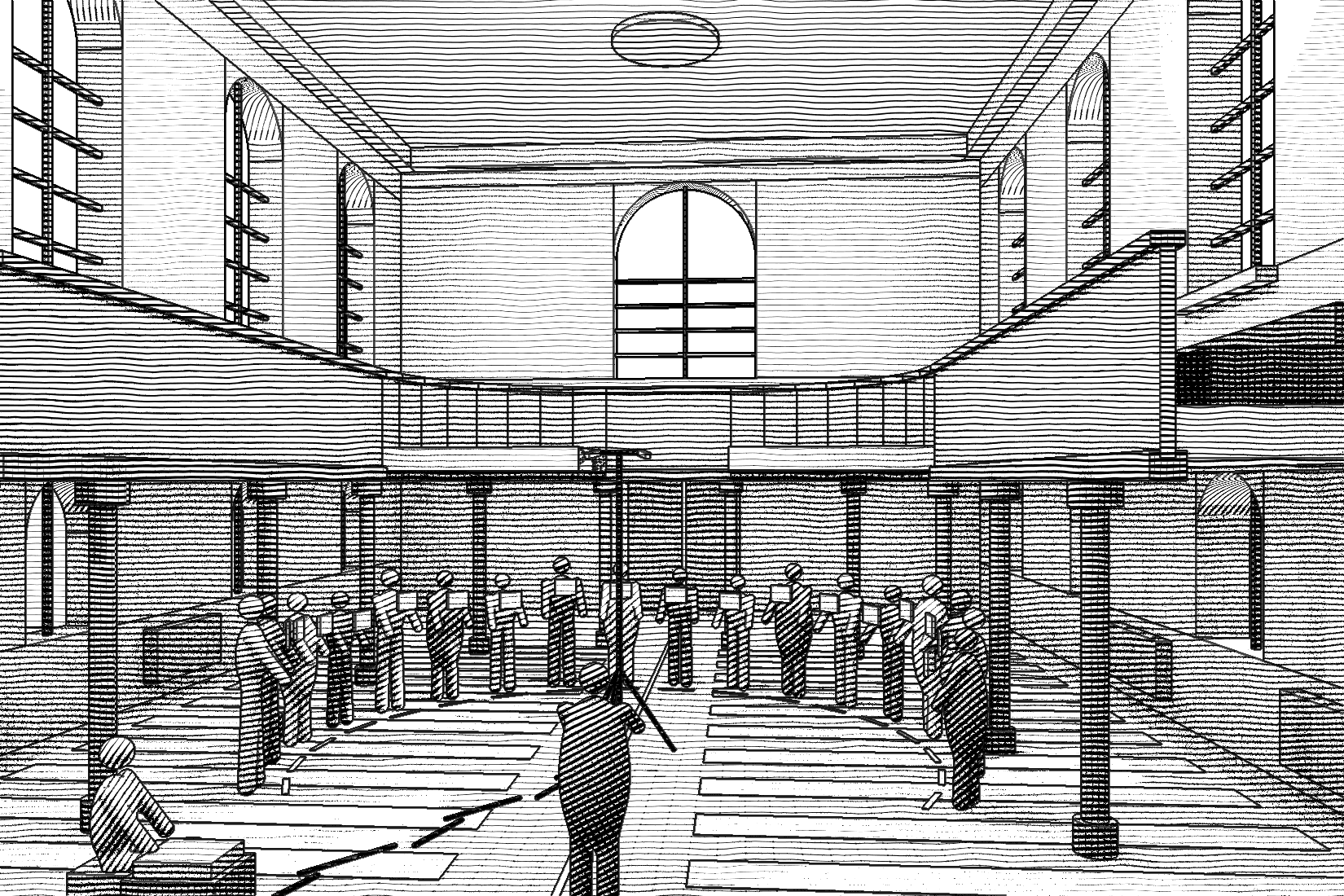
Saturday morning in the reading room of the old Asterby Free Library. The café moved in the spring after the county moved out. Engraving by Bram Keller
The ledger
The ledger is now in its 11th volume. The first three were bought at the post office, back when there was one. Each is a hardback accounts book with the columns relabeled in Walt’s capitals: number, item, fault, fix, outcome, fixer, owner. The outcome column takes one of four letters. F is fixed. P means a part is on order and the owner should come back. A means advice was given, which usually means the thing can be mended, but not here. N is not fixable, and Walt writes it noticeably smaller than the others.
“Capitals don’t argue,” he says, when asked why everything is in capitals. He is 74, broad and unhurried, with reading glasses pushed up into thick gray hair and the general air of a man who has been asked to take a look at something. He talks to objects more than to people, and more gently. To a vacuum cleaner with a snapped belt: “You’ve been working hard.” To a lamp someone had rewired at home, alarmingly: “Who did this to you?”
Asterby Repair Café ledger, vol. 11, p. 94
SAT 19 SEPT 2026 · OLD LIBRARY · WH / RP / NB · TEA PG
19140 · TOASTER 4-SLICE · WON’T STAY DOWN · LATCH SPRING · F · WH · IAN
19141 · SCHOOL TROUSERS AGE 9 · KNEES · PATCHED · F · RP · KERRY
19142 · PHONE · SCREEN CRACKED · PART ORDERED · P · NB · DOT
19143 · FAN HEATER · NO HEAT · ELEMENT GONE · n · WH · STEVE (ASK RE 2ND HAND)
19144 · PRAM · FRONT WHEEL WOBBLE · BEARING · F · WH · LAUREN
19145 · COAT, CHILD’S · ZIP · NEW ZIP · F · RP · KERRY
19146 · PHONE · WON’T CHARGE · FLUFF · F · NB · GRAHAM
19147 · ELECTRIC BLANKET · ONE SIDE COLD · CONTROLLER · A · WH · JEAN
19148 · ACCORDION · STICKY KEY · F · RP (SOMEHOW) · MICK
The first entries from Saturday, September 19. The small n is not a typo. Asterby Repair Café; reproduced with the permission of Walt Hennigan
Twelve years of Saturdays add up. To the end of August 2026 the ledger recorded 19,061 items. Two-thirds were fixed on the day; another fifth went home with advice or came back the following week to have a part fitted.† The ledger knows that clothing is the most reliably fixable thing people bring in (91 percent) and printers the least (11 percent). It knows that the first heaters arrive in the third week of September, before anyone needs one, because people in Asterby have learned. It knows that in the last week of every August, Rosa’s table disappears under school trousers.
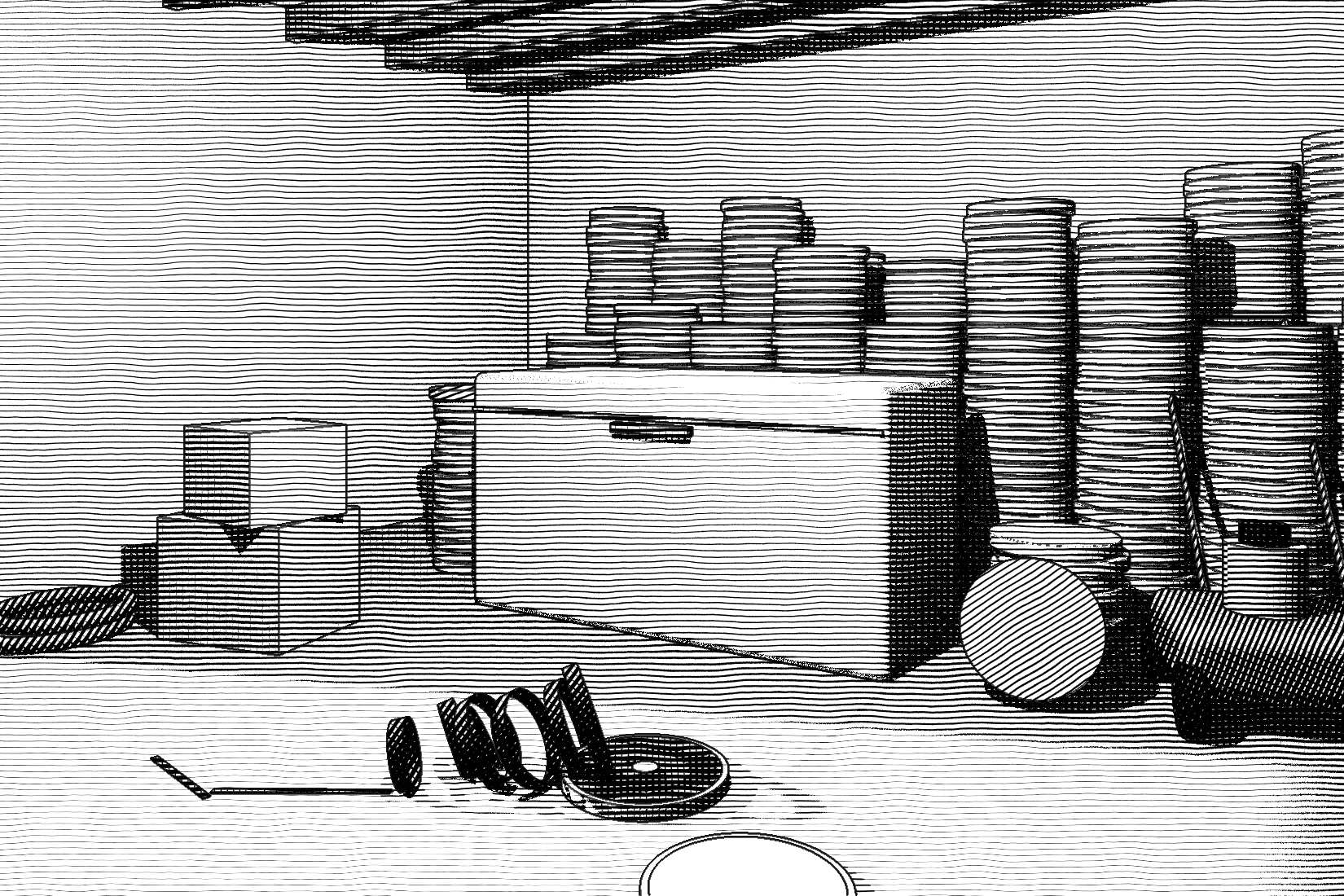
Nothing marked N goes to waste if Walt can help it. With the owner’s blessing, it goes onto a set of steel shelves behind his table that he calls the donor shelf, stacked with the carcasses of things that could not be saved: kettles with cracked bodies and sound switches, vacuum cleaners with dead motors and perfectly good hoses, and, as of that Saturday, a fan heater with a burned-out element and a working thermostat. About a fifth of the parts Walt fits come off that shelf. “Nothing dies here,” he says. “It just gets spread around.”
Three tables
There are three tables, and they correspond, roughly, to three eras of the town. Walt’s belongs to the last mill: motors, elements, switches, anything with a plug. Rosa’s is older than that. She is 69 and was one of Lathom’s last menders, spending 36 years at a sloped table in the mending room, finding faults in finished cloth by eye and by touch and working them invisible with a needle. She now mends whatever comes, wedding dresses and dog beds alike, from a biscuit tin of buttons sorted by color and size. She is fast, funny and unsparing, and she has a theory about her table.
“I can tell you who’s lost weight and who’s lost their job by what they bring me. Often it’s the same people.” Trousers taken in and then, a year later, let out. Coats patched at the elbows instead of replaced. School uniforms passed between families, with Rosa unpicking one child’s name tape and sewing in another’s. “Nobody brought me a coat to patch in 2015,” she says. “Now it’s six a week in the winter. Children’s, mostly. You’d think with children you’d get rid, because they grow. You don’t get rid. You patch it and pass it on.”
Kerry, who is 34 and has three children, brought a pair of school trousers and a coat that morning, items 19,141 and 19,145. The trousers had gone at both knees, and Rosa patched them from the inside with squares of gray twill cut from another pair, so that from the front you had to look twice. The coat needed a new zip, which Rosa had in her tin. Kerry watched the whole operation from the chair beside the table with a toddler asleep on her shoulder. A new coat, she said, would have meant choosing between the coat and something else that week. She did not say what the something else was, and Rosa did not ask. When it was done, Rosa held the coat up to the window to check that the zip ran clean. “That’ll see him to spring,” she said. “Then bring it back and I’ll let the sleeves down.”
The third table belongs to the present. Nico Brandt is 17, tall, quiet and almost entirely unimpressed, and he fixes phones. He first came three years ago with his grandmother, whose phone had stopped charging, and while she waited in line for Walt he took it to the empty end of Rosa’s table and fixed it himself, with a toothpick, in under a minute. The charging port was packed with pocket fluff. The following Saturday he came back with a guitar pick, his mother’s hairdryer and a set of tiny screwdrivers that had come free with a magazine, and he has been there every Saturday since.
I can tell you who’s lost weight and who’s lost their job by what they bring me.
— Rosa Pelling
Nico puts the case for his table more briefly than anyone. “Phones aren’t phones here. They’re the bank.” When the last branch closed, the nearest became a 40-minute ride away, on a bus that now comes every two hours. When the post office went, so did the counter where people collected pensions, paid bills and sent parcels back. Most of what those buildings did has moved into apps. The clinic by the bypass books appointments by text message; the electricity meter is topped up by phone. “If Dot’s phone breaks,” Nico says, naming a regular who is 81, “she can’t get her pension, she can’t see the doctor and she can’t put the heating on. So it’s not a phone. It’s, like, all of it.”
Dot’s phone, item 19,142, had a screen so badly cracked that the bottom third no longer answered her thumb, which happened to be where her banking app lived. Nico ordered a replacement screen at cost, paying for it himself until the tin pays him back, and in the meantime moved the app to the top of the screen, where the glass still worked, and showed her where it had gone. It took two minutes. She asked him to show her again, and he did, and then a third time, with no change at all in his voice. Then he wrote a P in the ledger and told her the part would be in by next Saturday, and she said she would see him then, as if there had ever been any doubt.
What can’t be replaced
Last winter, Nico typed the whole ledger into a spreadsheet: 11 volumes in four months, mostly on the bus. He did it, he says, because Walt kept saying things like “we get more heaters now” and Nico wanted to know whether it was true. It was. Read year by year, the spreadsheet shows a town’s budget shrinking in the shape of the things it carries through the door.
In 2015, the café’s commonest items were lamps, toasters, lawnmowers, vacuum cleaners and clocks: things people were fond of, or too thrifty to throw out. In 2025 the top five were phones, kettles, children’s clothing, heaters and vacuum cleaners. Heaters and electric blankets together rose from 14 items in 2015 to 121 last year. Walt, who regards the electric blanket as a sound piece of engineering, explains the logic without sentiment. “You heat the person, not the room,” he says. “Costs pennies. That’s what people are doing now. They sit under a blanket all winter, and when it stops they bring it to me.”
Phones climbed most steeply of all, from five in 2015 to 384 in 2025, nearly a fifth of everything logged. Some of that is Nico; word gets around. But the line was rising well before he arrived, through years when Walt could do little more for a phone than hand it back with an A and a bus timetable. People brought them anyway, Walt says, because there was nowhere else to bring them.
Phones brought to the Asterby Repair Café
Phones logged in the ledger each year. The 2014 figure covers May to December. Nico Brandt began fixing phones in the autumn of 2023; the last bank branch closed in 2016 and the post office in 2021. Source: Asterby Repair Café ledger, transcribed by Nico Brandt
Repair cafés were founded, for the most part, on an argument about waste: the conviction that a throwaway culture ought to learn to mend. Walt shares it, loudly. But very little that comes through the door in Asterby comes because its owner objects on principle to landfill. It comes because the alternative is going without. Only 54 percent of heaters can be saved. Walt keeps a list, taped inside the lid of his toolbox, of the people whose heaters he could not fix, and on Wednesday evenings he goes through the secondhand listings and calls them when something turns up. That list is not in the ledger.
Phones aren’t phones here. They’re the bank.
— Nico Brandt
Three cups per broken thing
If the ledger measures what Asterby can’t afford, the tea table measures what it can’t do without. Pat Gorley is 80 and does not fix anything. She arrives at half past nine to fill the urn, sets out cups on a trestle where the newspapers used to be, and counts them as they come back. On that Saturday in September, the café took in 42 items and served 139 cups of tea. “That’s three and a third cups per broken thing,” she says. “Nobody needs three cups of tea to get a toaster fixed.”
People wait about half an hour to be seen, and most stay well past it. The waiting has become the point. There is a man who brings in his late wife’s sewing machine every few months for Rosa to oil, and stays to talk about her. There are young mothers who come with a pram and a broken zip and leave with someone to swap babysitting with. The district nurse, whose clinic is out by the bypass, a bus ride that many of her older patients no longer make, now takes blood pressures at a card table by the door on the first Saturday of the month, because, she says, it is where the people are. A council member holds office hours by the urn; a man from the credit union comes in October to talk about winter bills. Nobody planned any of it. Things that used to happen at the post office counter, in the line at the bank and across the library desk have quietly re-formed around three folding tables and a tea urn.
“They come for the toaster,” Pat says. “Then they remember they’ve not talked to anybody since Tuesday.”
None of it is secure. The Asterby Community Trust holds the library building on a lease from the county that runs out in 2029. The café’s insurance has nearly doubled since 2020. Of its nine regular volunteers, the youngest after Nico is 58. Walt had a stent fitted in the spring. Rosa’s eyes are, in her word, “holding.” And Nico, who is in his last year of school, has applied for an apprenticeship at the Halbridge Transit Authority’s electrical depot, which is the trade, near enough, that Walt started in at 16. If he gets it, he will be living in the city by next autumn. He says he will come back on Saturdays. The first bus from Halbridge gets in at 9:52.
At ten to one, the last item of the day came in: a transistor radio, carried by Harold Pask, who is 86 and was a loom tuner for 40 years, first at the Dyehouse Lane mill and, after 1979, at Lathom’s.‡ The radio crackles when you turn the volume up. According to the ledger it has crackled on 88 previous Saturdays, and Harold’s name appears in the owner column more often than anyone else’s. Walt took the back off, sprayed the volume control with contact cleaner, worked it to and fro, and put the back on. The crackle went. It will return, because the control is worn, and the proper fix is a new part that Walt could have ordered at any point in the last four years. He has never quite gotten around to it.
By then Walt’s hand was tired. He pushed the ledger across the table to Nico without comment, and Nico, who had never written in it before, picked up the pen. “Capitals,” Walt said, not looking up. Nico wrote: 19181. RADIO. CRACKLE. CLEANED. F. WH. HAROLD. Above them the library clock, stopped on the day the county closed the building and restarted by Walt the week the café moved in, in the spring of 2019 (item 5,391; owner, Asterby), began to strike one. Pat started stacking cups. Harold switched his radio on, listened for a moment to it not crackling, and sat back down to finish his tea.
Notes
*Population figures are Asterby District Council estimates for the two central wards, Millgate and St. Anne’s: 6,940 in 1981, 4,180 in 2011 and 3,310 in 2025. Most of the town’s growth since 2000 has been in new estates near the bypass. Closure dates are from the council’s register of community assets and from the archive of the Asterby Advertiser, which itself ceased publication in 2017. ↩
†Nico Brandt transcribed all 11 volumes between November 2025 and February 2026 and has kept the spreadsheet current since, sorting items into 14 categories. The Margin checked a random sample of 400 entries against the original volumes and found nine we would have categorized differently, none in a way that alters the figures given here. Outcomes to the end of August 2026: fixed on the day, 66 percent; advice given, 11 percent; part ordered and later fitted, 9 percent; not fixable, 14 percent. ↩
‡Walt Hennigan, Rosa Pelling, Nico Brandt and Pat Gorley were interviewed in Asterby over four Saturdays in August and September 2026. Customers are identified by first name only, as they are in the ledger, at their own request. Harold Pask asked to be named in full, “so they know it’s me.” ↩