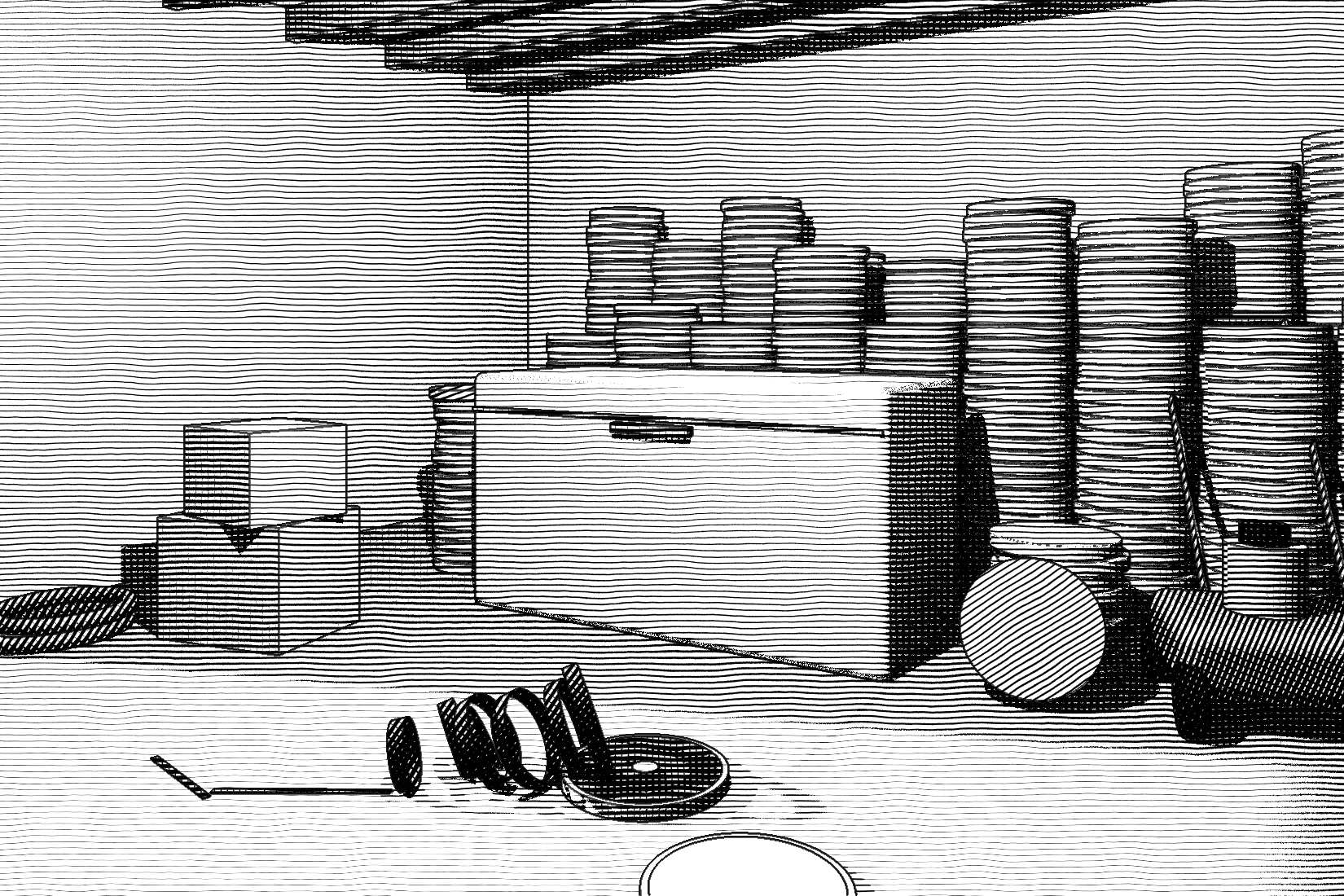
For 48 years, the footage for Vera Haskett’s unfinished documentary sat in a Norhaven garage, behind a chest freezer and under a broken lawn mower. Engraving by Ivo Petrak
The smell gets there first. On a gray morning in March 2023, in a cold room two floors beneath the Corran Film Archive, Celia Amankwah eased the lid off a rusted can labeled, in grease pencil, SR 23, and the air filled with the sour tang of a salad left out overnight. Inside, 400 feet of 16mm film had shrunk hard around its core and gone as stiff as a roof tile. Its edges had buckled into a shallow wave. When Amankwah tipped the roll toward the lamp, a fine white powder slid off it onto her gloves, as if someone had salted it.
“That one was going,” she told me this summer, in the voice a vet uses for a dog that came in too late. “Another couple of winters and it would have been a hockey puck.”
Funmi Adeyemi is the magazine’s critic at large, writing on film, music, and museums, and on the people who keep all three from falling apart. For nine years she programmed the Lantern, a repertory cinema on the Halbridge waterfront, and her essay collection The Dark Between Reels won the Calloway Prize for criticism. She lives in Halbridge, in an apartment with more film cans than chairs, and makes a rule of seeing everything twice: once from the front row, once from the back.
The mill closed, the bank left and the post office became a flat. On Saturday mornings, a folding table in the old library still fixes about forty things.
SR 23 is one of 40 cans that spent half a century stacked behind a chest freezer in a garage in Norhaven. Between them they hold a little over seven hours of footage for a documentary called The Salt Road, which the director Vera Haskett began shooting in the autumn of 1971 and stopped working on, abruptly and for good, in May 1974. She never cut it. She never said in public why. When she died in 1991, her obituary in the Westmere Courier ran to 140 words and mentioned her roses.
This summer, The Salt Road was finally shown—first at the Halbridge Film Festival in June, then in July in the parish hall of the town where most of it was shot. It runs 88 minutes. Every image and every sound in it was recorded by Haskett. Almost every decision about where those images and sounds now sit was made by somebody else: Amankwah, the archive’s senior film conservator, and Tomas Wren, a television editor of 40 years’ standing whom the archive hired, in his words, “to be the vandal.” It took them three years, and most of that time, they agree, went not on restoring or cutting but on arguing about a single question. How much of the ending was theirs to make?
Forty tins of paint
Callum Haskett very nearly took the cans to the dump. He is 34, a heating engineer, the grandson of Vera’s older brother, Arthur, and in October 2022 he was clearing Arthur’s house after his death at 96. The cans were two deep behind the freezer, under a tarp and a lawn mower that had not started since the 1990s. “I thought it was paint,” he told me. “Forty tins of paint. I thought, well, that’s Grandad.” Only when he pried one open on the driveway and a coil of film sprang out at him did he remember a family story about an aunt who had “done something with cameras” before moving north to teach art.
Vera Haskett was born in Westmere in 1929, the daughter of a harbor pilot. Through the 1960s she made short commissioned films for a regional trade board—12 minutes on galvanizing, nine on the new fish market—and was by every account good at them and bored stiff. The Salt Road was to be her first film of her own. Its subject was the Westmere saltings, a huddle of iron pans and brick furnace houses on the marsh east of the town, where salt had been boiled out of seawater for three centuries, and the old cart road along which that salt traveled inland to the dye works at Asterby. By 1971 the road was being replaced by a highway, the saltings were losing money to mined salt from inland, and the works had one master panner left. His name was Joss Penhale. He was 60, he had worked the pans since he was 15, and he appears in roughly two-thirds of the footage, usually holding a rake and saying something mildly rude about the camera.
Amankwah drove north the following week with a van, a box of acid-detection strips, and, on a colleague’s advice, a clothespin for her nose. The strips, which shift from blue toward yellow as acid builds up, turned some shade of yellow in 26 of the 40 cans. Nine reels were in what conservators call an advanced state of decay. Three had fused into solid discs that nobody has yet found a way to unwind.* Even so, she says, Haskett’s film was lucky. Heat and humidity drive the chemistry, and it had spent 48 years somewhere cold.
In the archive’s cold store in Corran, Vera Haskett’s 37 surviving reels now sit below freezing, beside three that cannot yet be opened. Engraving by Ivo Petrak
Dressing is early, onions is late
Almost every film made after about 1950 sits on a base of cellulose triacetate, a plastic adopted because, unlike the nitrate film that came before it, it does not burst into flame. Its weakness is slower and, conservators say, sneakier. Moisture in the air gradually breaks the base apart, releasing acetic acid—vinegar—and the acid hastens the very breakdown that produced it. Once a reel starts to smell, the process feeds itself. The base shrinks, curls, and turns brittle. The plasticizers that kept it supple sweat out as white crystals, the powder that came off on Amankwah’s gloves. The emulsion, the thin layer that carries the picture, does not shrink with the base, and so it buckles and lifts like old wallpaper. Cold, dry storage can slow the reaction to a crawl. Nothing reverses it.
A projector would have shredded most of Haskett’s reels; their sprocket holes had shrunk out of step with its teeth by as much as 2.6 percent. Instead the archive used a scanner that draws the film along by friction and photographs each frame as it passes, and fed the worst reels through at two frames a second, with a conservator standing beside the machine and one hand near the stop button. That works out to 12 minutes of scanning for every minute of footage, before anything goes wrong, and things went wrong often. By the end the archive had logged 1,900 hours of conservator time on 37 reels. The three fused discs went back, unopened, into a freezer at minus 4 degrees Fahrenheit, in case someone, someday, invents a better way.
Then came the more interesting problem, which was what to repair. Haskett’s camera had a fault in its gate that scratched a fine vertical line through every frame of reels 9 through 14; her notebook greets its return, in May 1972, with a two-word curse. Mold from the garage had bloomed in pale flowers across reels 20 through 26. Digital tools can erase either in an afternoon. Amankwah erased one. “The scratch is hers. The mold is ours,” she said. “We take out the garage. We leave in 1973.”
We take out the garage. We leave in 1973.
— Celia Amankwah
Color was harder, because in a sense the color was garage too. Haskett shot on a 16mm reversal stock whose cyan and yellow dyes fade faster than its magenta, and after five decades the whole of The Salt Road had drifted toward a sunburned pink: a marsh the color of strawberry milk, gulls like cotton candy. To grade it back the archive had two references. One was Haskett’s notebooks, which describe the sky as “dishwater” with dispiriting regularity. The other was Lorna Penhale, Joss’s granddaughter, who is eight years old in reel 17, learning to rake a pan with a tool twice her height, and who is now 62 and runs a guest house on the Westmere seafront. She sat beside the colorist in Corran for two days. When the first corrected frame of her grandfather came up, she said only, “Bottle green,” and pointed at his jacket. “Gran knitted it. You didn’t tell him it was a nice color, or he’d stop wearing it.”
Two endings, both lies
Haskett left three notebooks with the reels: 212 pages of shot lists, tape logs, expenses, weather, and the occasional grievance, in a quick, slanting hand that gets quicker when she is pleased. Wren read them twice before he looked at a single frame. Most of it is practical. One page is not. It is dated March 14, 1974, and Amankwah and Wren refer to it, with the weariness of people who have spent three years in its company, as “the page.”
Vera Haskett’s third notebook, page 41
14.iii.74. SALT ROAD: the ending.
(1) Reel 31. Last draw. J. walks off up the causeway.
Hold till he’s gone.
(2) Reel 38. Highway cutting at Asterby. Trucks, spray.
Salt on the road still. Not ours.
1 says it ended. 2 says it never mattered.
Both lies.
J. says: don’t make a funeral of me.
Show him the cut first. PROMISED.
Nothing goes out without the pans (tape 14).
The page the editors came to call “the page,” dated March 14, 1974. The final line is in a different ink and was probably added later. Haskett estate / Corran Film Archive
To understand it you need two dates. On November 9, 1973, Joss Penhale drew the last pan of salt at the Westmere saltings, and Haskett filmed it in one unbroken take on reel 31 while her recorder ran on tape 14. On April 22, 1974, five weeks after she wrote the page, Penhale died of a heart attack in his kitchen, and as far as anyone can establish, he had not seen a frame.† Haskett’s last notebook entry, on May 2, is a single word: Stopped.
Neither the archivist nor the editor claims to know quite what that word means. Wren thinks the film stopped with the man. “She’d made a promise she couldn’t keep anymore, and she was the sort of person who’d rather not finish than finish dishonestly,” he said. Amankwah reads the page less as a plan than as a list of objections. “Look at it. She has two endings and she’s crossed both of them out in her head. ‘Both lies.’ She wasn’t stuck because he died. She was stuck before, and then he died, and then she was stuck forever.”
Films completed after their makers have died, or walked away, make up a small and quarrelsome genre, and its arguments rarely change. One side holds that an archive’s job is to keep what exists, not to guess at what might have: scan the reels, file the notebooks, let anyone who cares look at every surviving frame. The other holds that a film nobody watches has not really survived. Amankwah came to the project from the first camp and Wren from the second, and each describes the other with the fond exasperation of a long marriage. “Celia would have been happy to put the rushes in a vault and hold a symposium,” Wren said. “A film that isn’t finished isn’t a film. It’s evidence.”
A film that isn’t finished isn’t a film. It’s evidence.
— Tomas Wren
They settled, in the end, on doing both. The archive made a preservation master of every surviving reel, uncut and in camera order, with every false start and every slate, and it is there for anyone who asks. The completed film carries a title card saying who did what. And before Wren made a single cut, the two of them wrote four rules on a sheet of paper and taped it to the wall of his edit suite in Halbridge. Her pictures. Her sound. Where the notebook decides, it decides. Where it can’t, say so.
For most of the film, the rules worked almost too well. Haskett circled her selects in the notebooks and sketched a running order inside the cover of the second one, and the first 70 minutes of The Salt Road are probably as close to her film as anyone could now get. It is, I should say, a very good film: unhurried, wry, built from long takes that trust you to keep looking. There is no narration. Penhale explains how to tell when brine is ready by the skin that forms on it (“like on custard, only you don’t eat it”). A highway surveyor sets up his tripod on the old cart road and never notices that he is being filmed by a woman sitting on a milestone. A brown dog of no fixed ownership follows the camera through most of 1972. Haskett’s eye is patient and slightly mischievous, and her only appearance on screen is a pair of hands.
The sound of the pans
Sound was another matter. Haskett recorded on quarter-inch tape with a portable recorder slung from her shoulder, and her notebooks log 27 tapes. Twenty-two turned up in a suitcase in Arthur’s loft; they had to be baked at low heat for a day and a half, in what is essentially a laboratory food dehydrator, before the oxide would stay on them long enough to be played.‡ Five are missing. One of them is tape 14. The last line on the page, in its different ink, is about it.
Ask anyone who heard the saltings working what they sounded like and you get the same pause, then a simile. The furnaces roared under the pans. The brine seethed. As the salt formed it gave off a fine, continuous crackle, which Lorna Penhale describes as “rain on a tent, if the rain was hot,” and which the men listened for the way a cook listens to a frying pan. Over it came the drag of the long wooden rakes, the knock of the salt tubs, and the gulls, who were always there. Haskett recorded all of it, for 11 minutes, on the morning of the last draw. Without it, the final sequence of her film is a man moving silently through steam.
Wren spent his career in television, where the answer is obvious. “You’d have the pans out of a sound library by lunchtime, and nobody would ever know,” he said. “I’ve done worse for a cooking program.” Rule two forbade it. But in October 2025, partly to settle the matter and partly, he admits, to win, he took a recordist to Westmere, where a heritage trust still fires one small pan twice a year for school groups, and recorded 40 minutes of salt being made. Back in Halbridge he laid the best of it under reel 31 and invited Lorna Penhale to listen.
She listened twice. “That’s a kettle,” she said. The demonstration pan is about the size of a dining table; the saltings had six pans each about the size of a tennis court, three furnaces, a brick chimney that drew like a train, and a corrugated roof that the steam rang on. “You can’t record a place that’s gone with a saucepan,” she told Wren. He says he was relieved, and that the relief told him something. The final four minutes of The Salt Road play in silence. A single card, white on black, comes up before them: Tape 14, recorded November 9, 1973, has not been found.
The cap
That left the pictures, and the page. Haskett’s second ending, the highway cutting at Asterby, with trucks flinging spray across a road salted with somebody else’s salt, had already found a home in the middle of the film, where it is the angriest five minutes in it. So the ending would come from reel 31, the last draw. Hold till he’s gone. Wren cut it that way first. Penhale rakes the final heap of salt from the pan, wipes his hands on his apron, and walks out through the pan-house door and up the causeway into the fog, and the shot holds, pan in the foreground and doorway beyond, until the fog has him. It is beautiful and very sad, and it is, Amankwah said when she saw it, a funeral.
Frames from reel 31, the last draw at the Westmere saltings, filmed in a single take on November 9, 1973. Engraving by Ivo Petrak
Because the rushes go on. Haskett did not switch off when Penhale left the frame. Reel 31 runs another 52 seconds on the empty pan house, steam thinning, salt drying white along the rim, and 31 seconds into that, Penhale walks back into shot. He has forgotten his cap, which is hanging on a nail by the furnace door. He takes it down, notices that the camera is still running, looks straight into it, and says something. Then he laughs, puts the cap on, and the reel runs out to white.
Haskett marked none of this. It sits outside the circle in her notebook, past the point where her instruction, read strictly, tells you to cut. For a while the preservationist and the vandal swapped sides. Wren argued for the obedient cut: she wrote gone, he goes, you stop. Amankwah, who had spent three years insisting that it was not their place to improve on Vera Haskett, argued that the only line on the page that came from Joss Penhale himself was the one about the funeral. “Cut when he walks away and you’ve buried him,” she said. “He told her not to. She wrote it down. And then he came back for his cap.” Rule three, they decided, cut both ways: the notebook did decide, it just took two lines to do it. Of the nine minutes in the film that come from footage Haskett never marked, those 52 seconds took the longest to agree on.§
In the parish hall at Westmere in July, 230 people sat on folding chairs to watch it, many of them old enough to have bought salt at the saltings and several of them, it emerged during the questions afterward, related to the owner of the dog. When the card about tape 14 came up, the hall went quiet in the particular way of a room full of people who know exactly what something sounded like. Then Joss Penhale came back for his cap, and the hall laughed, a big, surprised, family laugh, because half of it had watched him do exactly that at the end of a hundred shifts.
Afterward, in the parking lot, I asked Lorna Penhale what her grandfather says in that last shot, with the cap in his hand and his mouth moving and no sound at all. She did not hesitate. “He’s telling her to switch that thing off and come in for her supper,” she said. “He said it every night.” The film does not tell you this. Amankwah and Wren discussed a subtitle for about five minutes, which by their standards is no time at all, and agreed that this, at least, was not theirs to add. Tape 14 is missing by accident. The subtitle is the only thing in The Salt Road that is missing on purpose.
Notes
*Figures from the Corran Film Archive’s condition survey of the Haskett deposit, March–April 2023, shared with The Margin. Shrinkage was measured on each reel against a reference gauge and ranged from 0.4 to 2.6 percent. The three fused reels, numbered 6, 33, and 39 in Haskett’s log, are listed as “not currently recoverable”; her notes indicate that they held the cart road in snow, a harvest supper, and an interview with a carter’s widow. ↩
†Penhale’s death was registered at Westmere on April 24, 1974, with the cause given as coronary thrombosis. Lorna Penhale says her grandfather never mentioned seeing any of the film; the notebooks record no screening, and Haskett’s expenses for 1974 include no hire of a projector or viewing room. ↩
‡The tapes were held at 130 degrees Fahrenheit for 36 hours, a standard treatment for tape whose binder has absorbed moisture, then digitized in a single pass each. The missing five are numbers 3, 9, 14, 25, and 26. The archive has written to the families of Haskett’s known collaborators and to two regional broadcasters, so far without success. ↩
§The completed film runs 88 minutes. According to the editors’ cut list, which records the source reel and notebook reference for every shot, 79 minutes come from footage Haskett circled as selects and nine from footage she left unmarked, the final 52 seconds among them. The preservation master of the 37 surviving reels runs six hours and 47 minutes. ↩