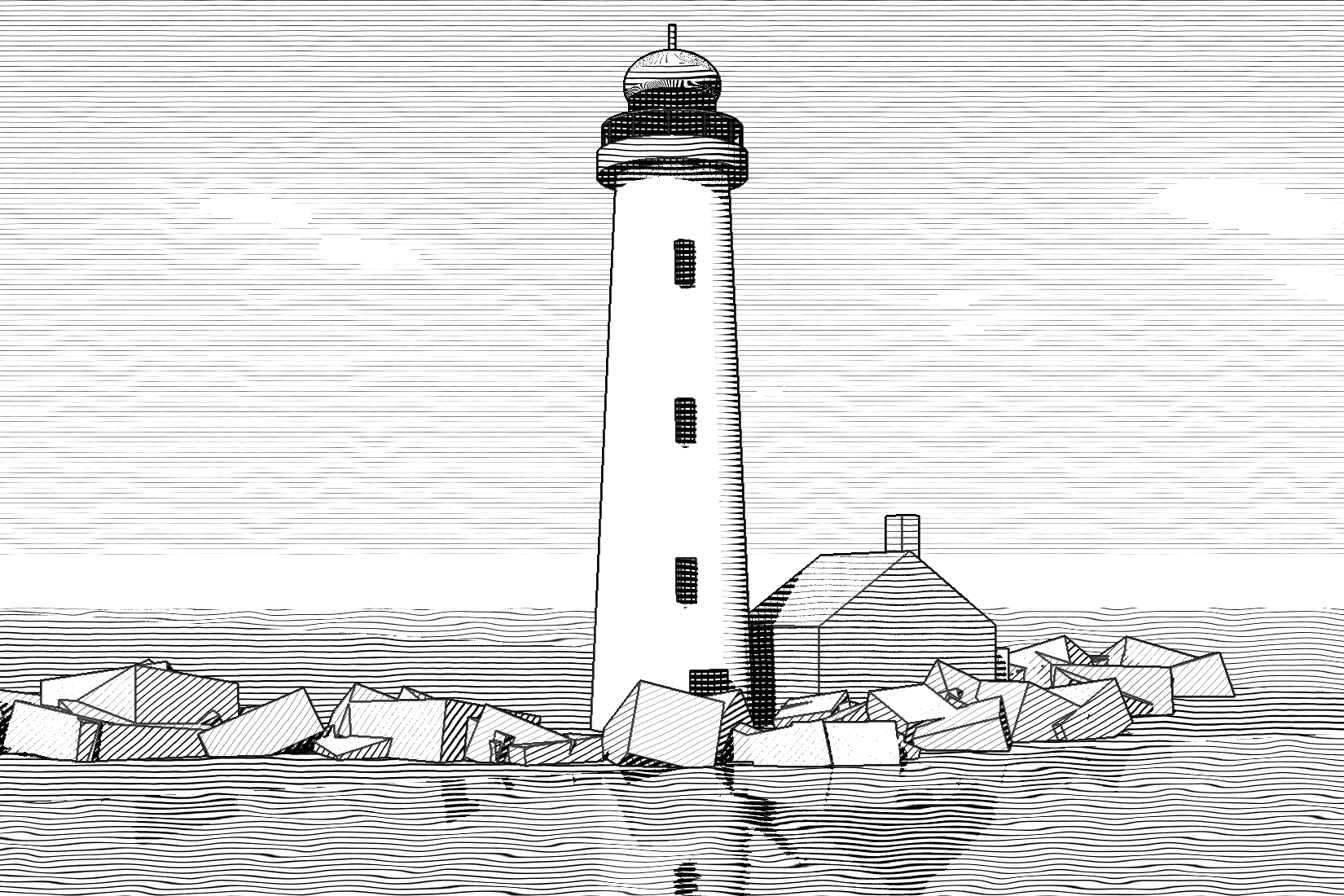
Skerrow light, nine miles off Port Ellery, has kept itself since 1996. Its keepers are still keeping its records. Engraving by Ottilie Marsh
Every keeper remembers the last night of the lamp. For Edda Marrow it was a Tuesday in February, and she will tell you about it eventually, in order, the way she would have written it up. But not first. First she wants you to understand the weather.
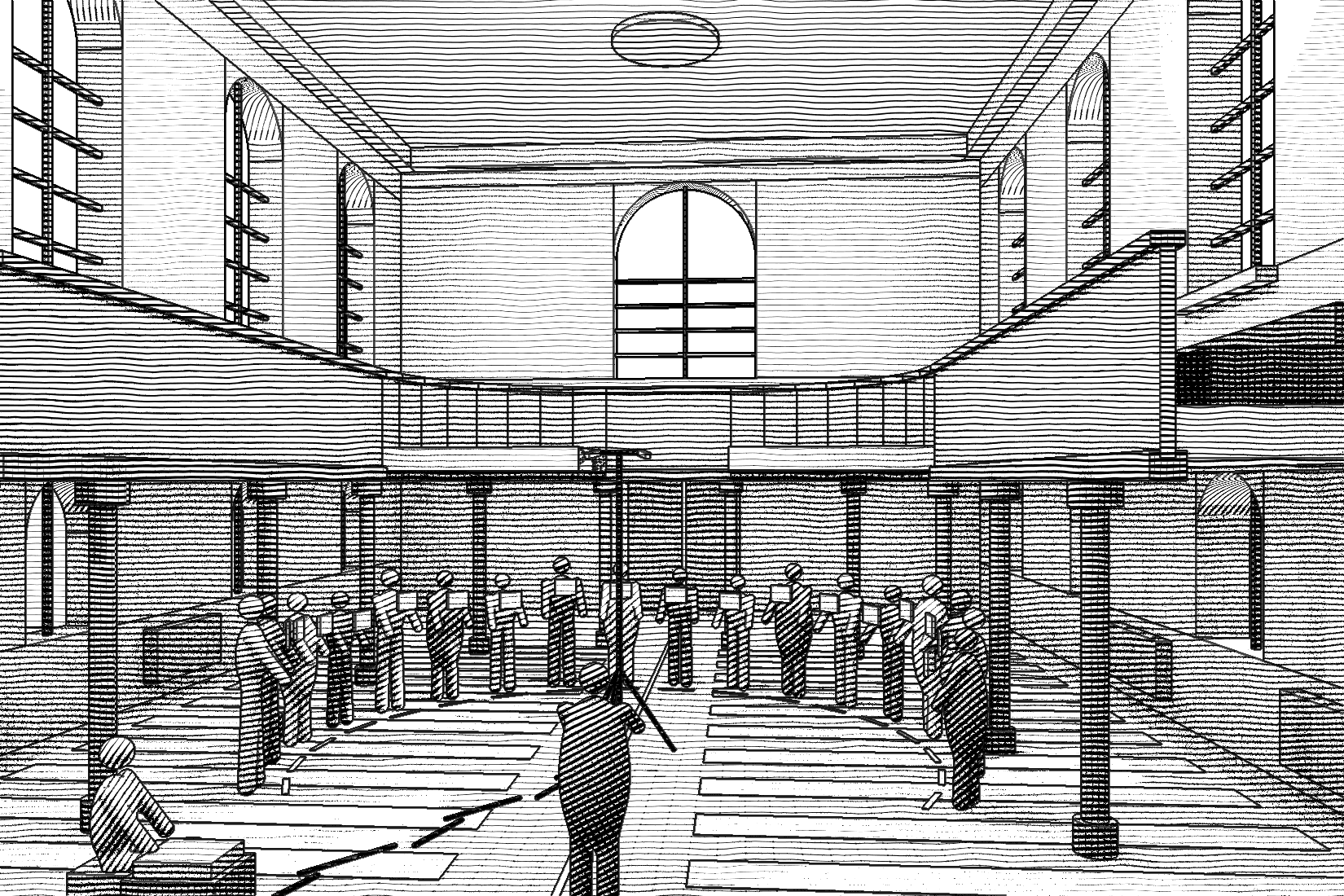
On the second Thursday of every month, a dozen or so retired lighthouse keepers climb the stairs of Port Ellery Town Hall to the Corn Room, a long, drafty room above the harbor where grain was once auctioned by the sack. They bring flasks, ginger cake and reading glasses on cords. Mira Toft, the project archivist, has been there since eight, laying out what she calls the furniture of the job: two folding tables, a flatbed scanner, a laptop, a dehumidifier that hums like a generator two rooms away, a box of cotton gloves, and the morning’s journals in gray archival boxes, each labeled with a station and a span of years. At the far end, two clothes rails hung with moving blankets make a booth for recording. Through the long windows, on a clear day, you can see Skerrow: a low gray island nine miles to the southwest with a white tower on it, small enough to cover with your thumb.
Ruth Hollis is a senior writer who covers work, craft, and the small places that larger stories tend to skip—village bakeries, repair cafés, lighthouse towers, and a cinema rebuilt one seat at a time. She spent seven years as a deckhand on the Port Ellery ferry before turning to journalism, and her first book, Open Until Six, followed a year in the lives of 12 coastal shopkeepers. She still lives in Port Ellery, takes notes in a shorthand nobody else can read, and always buys something from the people she interviews.
The mill closed, the bank left and the post office became a flat. On Saturday mornings, a folding table in the old library still fixes about forty things.
In September, Edda sat at the end of the nearer table with Skerrow’s journal for 1984 open in front of her and read it aloud while Davey Lusk, who served under her for seven years, typed. “Oh-three-hundred,” she read. “Wind south-southwest, six. Rain. Visibility moderate. Sea rough. Barometer nine-nine-four, falling.” Davey typed. “Oh-six-hundred. Wind southwest, seven.” She read 30 entries in this way, steadily, as if reading out a shopping list, until she reached a line in the Remarks column and stopped. “AK Marrow’s birthday,” she read. “Cake.” She looked over her glasses at the room. “It doesn’t say whether it was any good. That tells you it wasn’t. Corin made it.”
Edda is 71. She kept the Skerrow light for 13 years, the last eight as principal keeper, and then spent 18 more selling tickets in the Port Ellery ferry office, which she describes as the same job with worse weather information. She is small, upright and exact, with short white hair and a habit of answering the question you should have asked instead of the one you did. She has come to the Corn Room every month for three years. She does not, she would like it understood, find any of this moving.
What she finds it is necessary. This is the Coastal Lights Oral History Project, and for three years it has been doing two things at once, against two different clocks. The first is transcription: 1,140 handwritten station journals from 31 lighthouses, kept between 1871 and 1997, are being typed up line by line before the paper gives out.* The second is recording. The men, and the handful of women, who wrote the last of those journals are being interviewed at length before they give out too. So far the project has transcribed 212 volumes and recorded 64 keepers. Eleven keepers have died since it began. Four of them were still on the waiting list.
“It’s in order of age,” Mira says of the list. She is 29, with a pencil behind one ear and another holding up her hair, and she says it the way you might confess to a bad habit. “I hate that it’s in order of age. But what else would you do?”
It is an odd thing to try to archive: a job that no longer exists, done by people who are still here to explain it, recorded in books that are mostly about something else. The journals are full of wind and ships and the exact minute the lamp was lit. They say almost nothing about what it was like to light it. The project is an attempt to keep both, the record and the people who can read it, and to find out before it is too late whether either is much use without the other.
Skerrow from the end of the harbor wall at Port Ellery. On clear nights its signature, two white flashes every 15 seconds, can be seen from the town hall’s upstairs windows. Engraving by Ottilie Marsh
A job in columns
For most of the 20th century, the Coastal Lights Authority employed about 300 keepers to tend some 70 staffed lights along this coast. At the rock and island stations they worked in threes, four weeks on and four ashore; at the shore lights they lived with their families in whitewashed cottages, and their children walked to school along the cliff. The work was, in its essentials, unchanged for a hundred years. Light the lamp at sunset. Put it out at sunrise. Keep it turning, keep it clean, keep watch. Every three hours, day and night, a keeper went out onto the gallery, read the instruments, looked at the sea and wrote down what he saw. Occasionally she did.
Then the lights began to keep themselves. Electric lamps replaced paraffin; lamp changers learned to swap a failed bulb unaided; radio telemetry let an office in Halbridge know that a light had faltered before any ship did. Station by station, the keepers were withdrawn. In 1961 there were 71 staffed lights. At the end of 1986 there were 14, and by the spring of 1997 there were none.† The Authority now runs 63 lights from a single control room in Halbridge, where one duty officer watches the whole coast on two screens.
Staffed lights on the coast, 1961–1997
Year-end count of light stations with resident keepers. The Authority automated its last 14 between January 1987 and March 1997; Skerrow went in February 1996. Source: Coastal Lights Authority annual reports, compiled by the Coastal Lights Oral History Project
The journals themselves are tall cloth-bound books, about the size of a parish register, ruled by the Authority’s printer into columns: date and hour, wind direction and force, weather, visibility, state of sea, barometer, lamp, fog signal, vessels passing, remarks. The columns barely changed between 1871 and 1997. The handwriting changed constantly. Mira can now date a Skerrow page to within five years by the slope of its letters. The keepers can do better. They can tell you who wrote it.
A station journal at the lantern-room desk. For 126 years, on 31 stations, someone wrote in one every three hours, day and night. Engraving by Ottilie Marsh
This is the whole reason the work happens in the Corn Room rather than at a scanning bureau. In 2024 the project tried a handwriting-recognition program on 40 sample pages; it read 61 percent of the words correctly and almost none of the abbreviations. The keepers read nearly all of them. “That’s Gil Abery,” Lew Gattis said one morning, glancing at a 1968 page over someone’s shoulder. “He crossed his sevens, like a Frenchman. That’s not a one. That’s force seven.” Lew is 80 and refuses to be recorded. “I wrote it down at the time,” he says. “That was the job. I’m not doing it twice.” He has nonetheless come to every session for three years and has corrected, by Mira’s count, a little over a thousand mistakes, most of them other people’s.
Skerrow Light Station journal, vol. 52
SKERROW LIGHT STATION · STATION JOURNAL · VOL. 52
Tues. 14 Nov. 1989 · PK E. Marrow · AK D. Lusk · AK C. Vass
11.40 MV Brenna Joy NE-bound, close in. Called her up. All well.
Remarks: No. 2 generator oil changed. Bread rose at last.
16.14 Lt exhibited.
21.00 W 8 · gale · vis. good · sea v. rough. Gannet in gallery, removed (bit DL).
A day in November 1989, in Edda Marrow’s hand. Times are those of the three-hourly observations; the keepers’ own business goes in Remarks. Coastal Lights Oral History Project, Port Ellery Maritime Museum
Most of a journal is weather. The rest lives in the Remarks column, which the Authority intended for defects and official visitors and which the keepers used, over 126 years, for everything else. A Skerrow keeper in 1931: “Cat overboard. Cat recovered. Cat unrepentant.” In 1964: “AK Bellamy’s daughter born, 6 lb 2 oz. He will see her on the 19th.” That was 11 days off, the date of the next relief. In 1977, after a week of gales had kept the relief boat in harbor: “Down to tinned peaches.” And the following afternoon, in the same hand: “Peaches finished.”
“This is where the people are,” Mira says, running a gloved finger down the column. She grew up in Asterby, inland, and had never been closer to a lighthouse than a postcard before she applied for the job, which she assumed would be about maritime history. It turned out to be about something stranger. Almost every remark records a thing someone noticed, a bird or a smell or a ship that came too close or a cake that failed, on a night when there was nothing else to notice. “The weather columns are data,” she says. “The remarks are the job. I thought I was archiving lighthouses. I’m archiving attention.”
The bricks
None of it was supposed to survive. When a station was automated, its journals were boxed and sent to the Authority’s buoy depot in Halbridge, a corrugated shed on the outer quay where navigation buoys were scraped, painted and stacked for the winter. There the boxes stayed, through 25 winters and a roof that leaked at the west end. In the autumn of 2022 the Authority sold the depot to a developer, and a clerk in its estates office was asked to arrange for the “legacy paper” to be pulped.
The clerk’s mother was a keeper’s daughter. She telephoned Arno Penhale. Within a week Arno, Lew and four others had borrowed a furniture van and moved 1,140 journals, in 96 trips up a loading ramp, to a lock-up garage in Port Ellery. “Nobody asked us,” Arno says. “Nobody stopped us, either. I should think that’s most of history.”
I thought I was archiving lighthouses. I’m archiving attention.
— Mira Toft
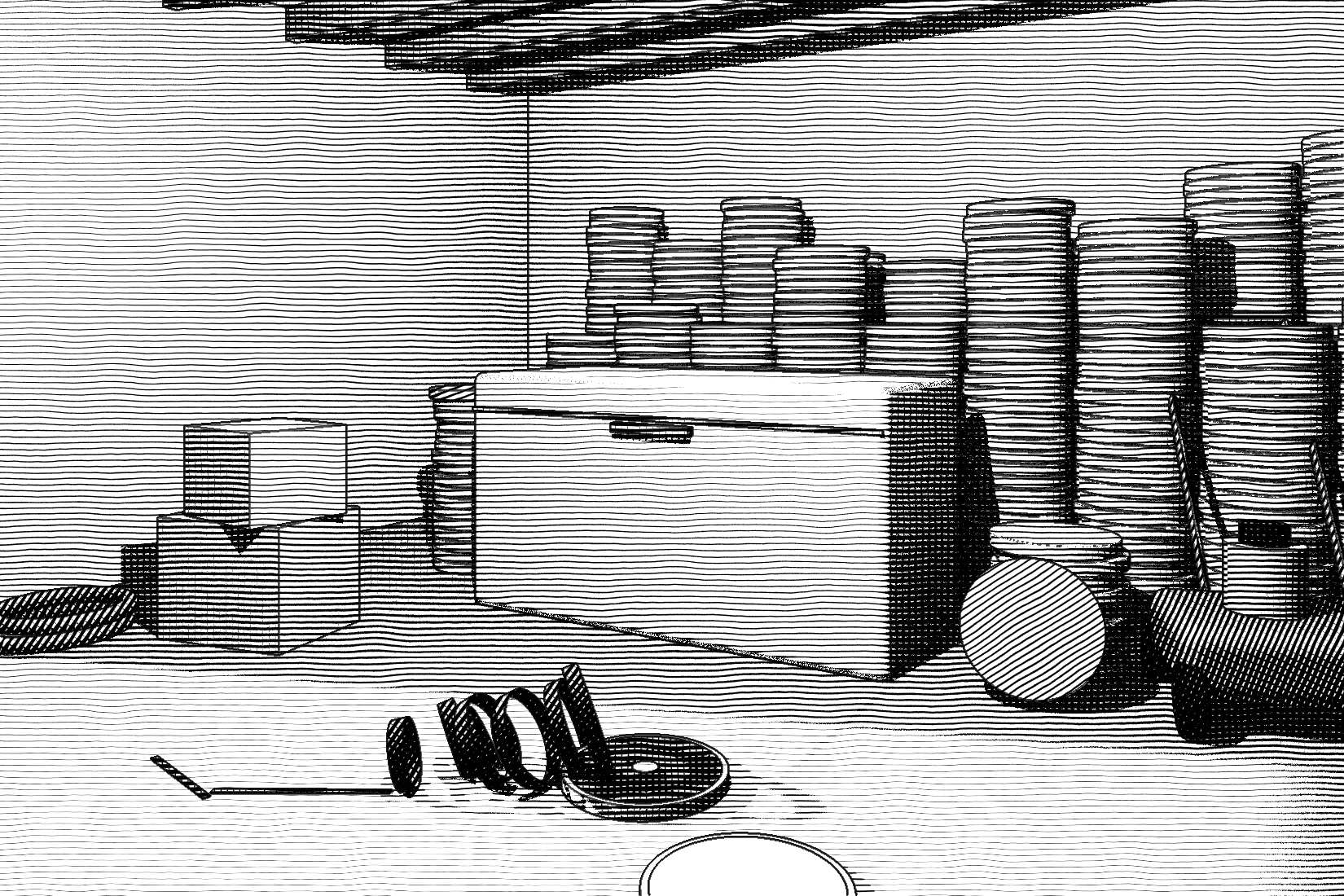
What they had rescued was in poor shape. When the Halbridge Maritime Trust agreed in 2023 to pay for Mira’s post and for a cool, dry room in the basement of the Port Ellery Maritime Museum, her first job was a condition survey. She found active mold in 186 volumes. Twenty-three were what conservators call blocked and what Mira calls bricks: books in which damp had fused the pages into a single solid mass that can no longer be opened without tearing. The bricks sit in a chest freezer in the museum basement, alongside, as of September, a tub of the curator’s ice cream.
This is the arithmetic Mira lives with. At the current pace, six or seven volumes a month, most of them transcribed in the Corn Room by pairs of keepers who can read each other’s hands, the remaining 928 journals would take more than 11 years. The project has traced 47 living keepers. Their average age is 78; the youngest is 61. The paper, she has come to think, is the less urgent problem. Paper can be frozen. “You can scan a page in a minute,” she says. “You can’t scan the man who knows what it says.”
Write down that it was boring
The recordings happen behind the moving blankets, one keeper at a time, with Mira asking questions from a list she has rewritten nine times. The first versions asked about storms, rescues and ghosts. The keepers were polite about it. “People want the storms,” Edda says. “Storms were the easy part. In a storm you know exactly what to do. It’s the other three hundred and fifty nights.”
What the recordings capture, slowly, is those other nights: the craft of a job that was mostly looking. Arno, who started on paraffin lights in 1958, describes the clockwork that turned the lens, driven by a weight on a cable that dropped down the center of the tower and had to be wound back up by hand every 40 minutes, all night, for as long as it was dark. Davey describes knowing that fog was coming an hour before it arrived, by the smell (“like a cellar,” he says, “or a wet dog”) and starting the fog signal early, to spare the ships the gap. Edda describes the middle watch, midnight to four, when there was nothing to do but be awake, and when a keeper’s only real task was to notice if anything changed.
Edda Marrow on the middle watch
0:00 / 3:16
An excerpt from oral history CLOH/041, recorded behind the moving blankets in the Corn Room, Port Ellery Town Hall, in May 2026. Coastal Lights Oral History Project
“It was looking,” she says. “Four hours at a time, for 17 years. I can still do it. I can sit at a window all afternoon and not be bored, which my grandchildren find frightening.” She thinks about what else to say, and decides. “You don’t keep a light. The light keeps you—awake, mostly.”
There is a pull, in a project like this, toward the romantic: the lone figure at the gallery rail, the beam sweeping the dark, the storm-lashed tower on the lid of a biscuit tin. The keepers resist it with something close to irritation. When a television producer asked Arno in 2024 whether he had been lonely, he replied that he had shared a tower with two other men for a month at a time and would have given a good deal to be lonely. Edda’s instruction to Mira, issued at their first session and repeated at most of the others, is brief. “Write down that it was boring,” she said. “Somebody has to.”
You don’t keep a light. The light keeps you—awake, mostly.
— Edda Marrow
It is not obvious what an archive of a vanished job is for. A building can be preserved, a tool put in a case. A job is a set of habits, and habits live in bodies. When the bodies go, what remains are the outputs, the journals and photographs and polished brass, and outputs read on their own mislead. The journals make keeping look like meteorology. The photographs make it look like solitude. The hope is that a reader, a century from now, can hold a page in one hand and a voice in the other and work out, between them, what the job was. “You can’t archive a job,” Mira says. “You can archive people describing it, and the things it left behind, and hope there’s a shape in between.”
Who reads the weather
The journals already have readers, and not the ones anyone expected. Oona Garvie, a climatologist at the Marine Climate Unit in Halbridge, first climbed the stairs to the Corn Room in 2024, looking for barometer readings. Before satellites, she explains, the weather over this coast was recorded mostly on land, at stations that were moved, closed or carelessly kept. The lighthouses were none of those things. Thirty-one of them, out on the edge of the sea, wrote down the pressure every three hours for up to a century, in the same columns, by people who were trained, inspected and (this is her point) had nothing else to do.
“It’s the densest weather record this coast has before about 1960,” she says. “And it was sitting in a shed.” Her team has so far checked 9,412 Skerrow pressure readings against independent records, and nearly all of them hold up.‡ Using the keepers’ numbers, they have redrawn the track of the gale of November 1927, which sank seven Port Ellery trawlers and which the official record had placed 60 miles too far north. The families of two of those crews still live in the town. Garvie sent them the new map.
Other readers come for the handwriting. In the spring, a woman drove over from Westmere with a photograph of her grandfather in uniform and asked whether she could see something he had written. Mira found him in the Gannet Stack journal for 1949: three months of weather in a careful, upright hand, and a single remark. “Wrote to M.” The woman’s grandmother was called Margaret. She photographed the page and then sat with it for some time, and nobody at the table hurried her.
And then there are the keepers themselves, for whom the project has turned out to be something its funders did not exactly budget for: a reason to be in the same room. The Retired Keepers’ Association has met for lunch since 1998, but lunch, Davey says, ran out of things to say around 2010. The journals gave them something to do with their hands and something to argue about: who wrote what, whose station had the worst relief boat, whether “moderate” meant the same thing in 1953 as it did in 1993. “We were the archive,” Arno says. “Every three hours for a hundred-odd years. It took everyone a while to notice.”
It is maintenance, all of it: the dehumidifier, the cool room, the freezer, the old men correcting one another’s sevens. The lights themselves are maintained now by technicians who fly out twice a year, replace whatever the telemetry says has failed, and fly back the same afternoon. What nobody maintains anymore is the watch, the habit of a person looking at the same piece of sea every three hours and writing down what is there. If it is kept anywhere, it is kept in the Corn Room, on the second Thursday of the month, between ten and one.
The last night of the lamp
Edda tells it in order, the way she would have written it up.§
The engineers had been on Skerrow for three weeks, and on the afternoon of Tuesday, February 20, 1996, they finished. The new equipment sat in the lantern like a guest who has arrived early and doesn’t know where to put his coat: a lamp changer with four bulbs on a carousel, a gray telemetry cabinet and, bolted to the gallery rail, a photocell about the size of a matchbox. The engineers’ boat left at three. That left Edda, Davey Lusk and Corin Vass, one more night of watches, and a helicopter booked for ten the next morning.
At 5:26 p.m.—17.26, the time printed in the Authority’s tables for sunset at Skerrow—she lit the light. By then lighting it meant pressing a switch; she has never once called it switching on. She took the first watch. At six she went out onto the gallery and read the instruments: wind west-southwest, force four; fine; visibility good; sea moderate; barometer 1012 and steady. She wrote it down. At nine she did it again. Nothing passed. At midnight she gave the watch to Davey, went down to her bunk and did not sleep.
At three she went up anyway and found Davey on the gallery with two mugs, one already poured for her. Corin was asleep. “Corin could sleep through a fog signal,” she says, “and did, for nine years.” The two of them stayed out there for the rest of the middle watch. She doesn’t remember that they talked. She remembers the light going round above them, two white flashes and a long dark, two flashes and a long dark, and the beam laying itself out across the water toward Port Ellery, where, as far as she knew, nobody was looking.
At 7:29 a.m. she put out the light and wrote “Lt extd 07.29” in the lamp column. Then, as keepers did when a journal was finished, she ruled a line across the page, signed beneath it, and made the station’s last entry in the Remarks column: “Station automated this date. Keepers withdrawn. All well.” The helicopter came at ten. The journal went to the buoy depot. Twenty-six years later, Arno Penhale carried it up a loading ramp in his arms.
That evening she walked to the end of the harbor wall in Port Ellery, where families had once stood to watch for the relief boats, and waited. Sunset was at 5:28. Nothing happened. The photocell, she explains, waits until it is properly dark; keepers never had that luxury. At 5:33 Skerrow came on: two white flashes, a long dark, two flashes. “Five minutes late,” she says. “On its first night.”
She had a pen in her coat. She went through her pockets for something to write on and found a receipt from the ferry kiosk for a cup of tea, and on the back of it she wrote: “17.33 Lt exhibited. Wind WSW 4. Vis. good.” She kept the receipt in her purse for 30 years. In September she brought it to the Corn Room and gave it to Mira, who accessioned it, with some ceremony, as the final entry in the Skerrow journals. Edda would like it known that this was not her idea. “Habit,” she says. “Don’t make anything of it.”
But that night there was no one to give it to. She stood on the harbor wall until she was cold, and then a while longer, watching a light she no longer kept do exactly what it had always done. Two flashes, a long dark. Two flashes, a long dark. Nine miles out, for the first time in 125 years, nobody was awake on Skerrow to write it down.
Notes
*Figures are from the project’s accession register as of September 30, 2026. The earliest journal was opened at Skerrow on November 1, 1871; the latest was closed at Hollin Head on March 12, 1997. Transcriptions are diplomatic: spelling, abbreviations and crossings-out are kept as written, with expansions supplied in brackets. “If I tidy it,” Mira Toft says, “I lose them.” ↩
†Year-end counts of staffed stations are taken from the Coastal Lights Authority’s annual reports, 1961–1997, and checked against the journals themselves; where the two disagree, usually by a month or so, the project has preferred the journals. The Authority’s present total of 63 lights includes 11 built since automation began, which have never had keepers. ↩
‡O. Garvie and S. Brandvold, “Pressure observations from light-station journals, 1871–1996,” Halbridge Marine Climate Bulletin 41 (2025). Of the 9,412 Skerrow readings compared with ship and shore records made within an hour and 30 miles, 94 percent agreed to within 1.5 hectopascals. Most of the remainder were traced to errors in transcription rather than to the keepers. ↩
§Edda Marrow was interviewed five times in Port Ellery between May and September 2026, and her recorded oral history is held by the project as CLOH/041. Her account of February 20 and 21, 1996, has been checked against the final Skerrow journal and against Davey Lusk’s separate recording, CLOH/052, which differs from hers only on the question of who poured the tea. ↩