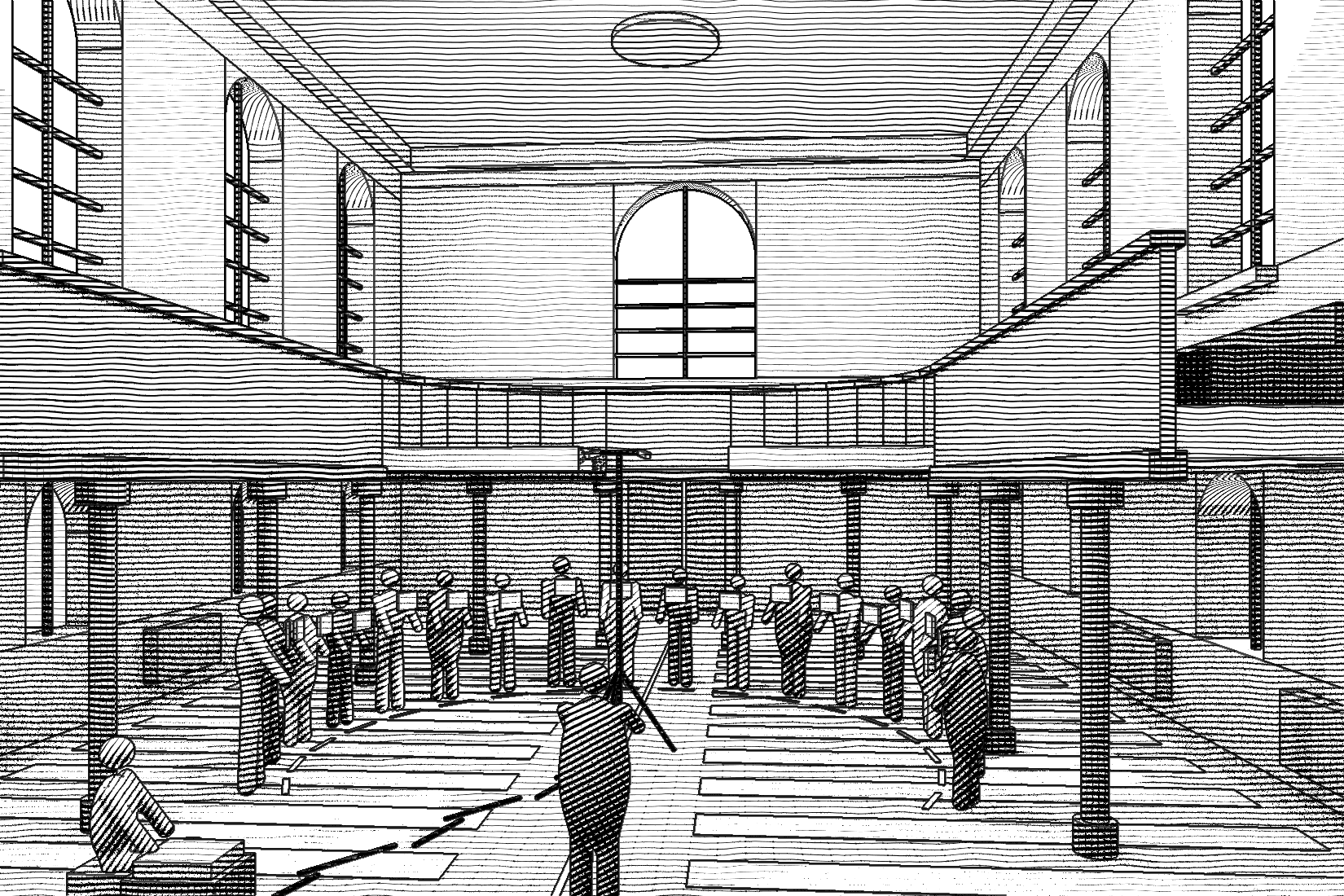
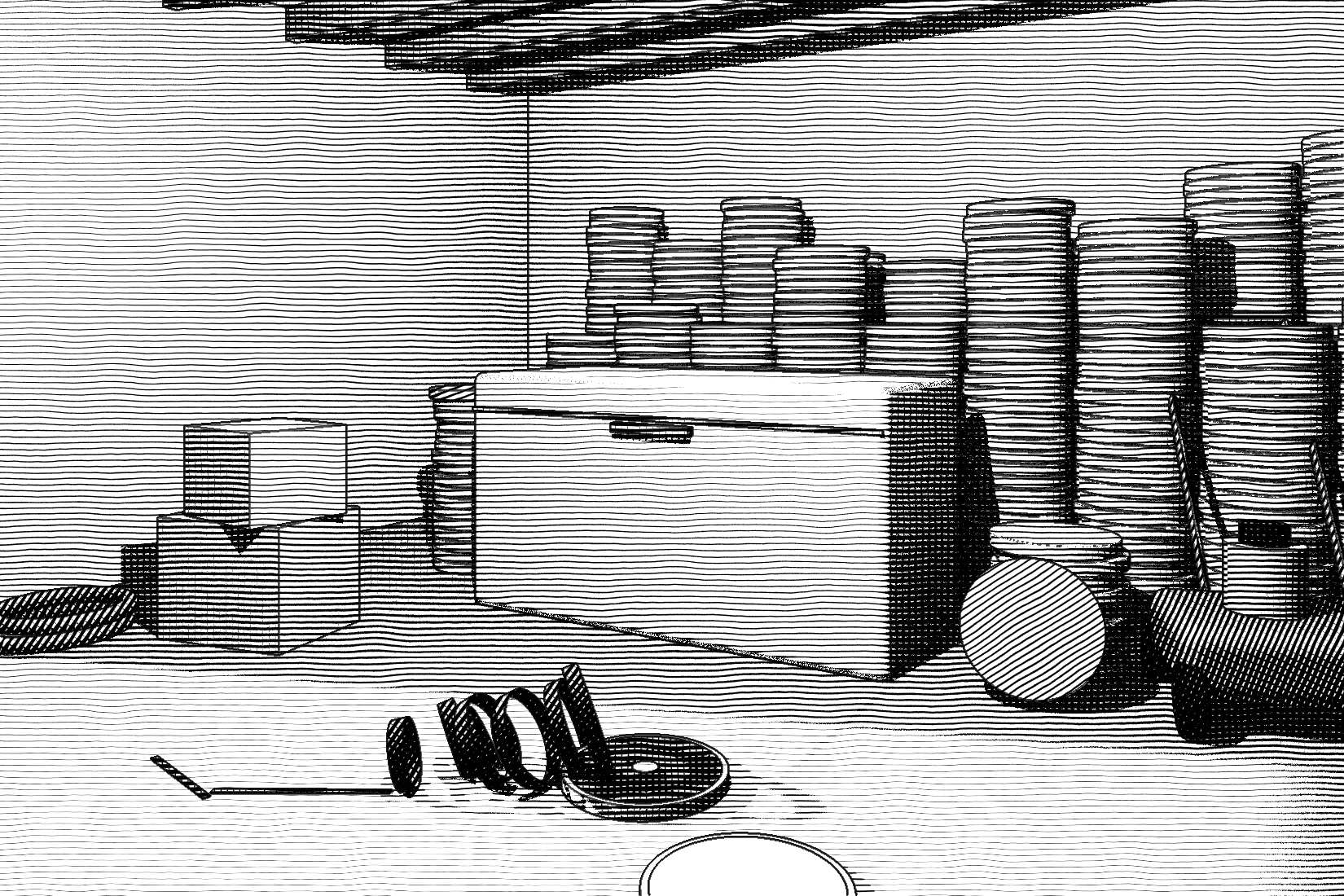
Two days before the scaffolding went up, the Reverberation Society sang one last piece in Providence Chapel, Asterby. Engraving by Sunniva Holt
At 11:40 on a Saturday morning in August, Ned Calloway climbed the pulpit steps of Providence Chapel in Asterby, held a red balloon at arm’s length over the empty floor, and stuck a hatpin into it. The bang went off like a starting pistol. Then the chapel took it: up into the gallery, along the plaster ceiling, back down from the alcove where the organ used to be, rolling and thinning until it was less a sound than a rumor of one. On a laptop balanced on the communion rail, a jagged green line sloped toward the bottom of its graph. “Three point four,” Calloway announced, and 17 singers in coats murmured, the way a crowd at a racetrack murmurs over a decent time.
The chapel was built in 1868 by the family that owned Asterby’s largest mill, and it seated 600. Its last service, in April 2021, drew 14. The pews went to a reclamation yard in 2024, leaving pale rectangles on the floorboards where their ends had been screwed down, and in May 2025 the building was sold to a developer who will turn it into six flats. The scaffolding was due on Monday. Which is why, two days before, the Reverberation Society had come to sing in it.
Funmi Adeyemi is the magazine’s critic at large, writing on film, music, and museums, and on the people who keep all three from falling apart. For nine years she programmed the Lantern, a repertory cinema on the Halbridge waterfront, and her essay collection The Dark Between Reels won the Calloway Prize for criticism. She lives in Halbridge, in an apartment with more film cans than chairs, and makes a rule of seeing everything twice: once from the front row, once from the back.
The mill closed, the bank left and the post office became a flat. On Saturday mornings, a folding table in the old library still fixes about forty things.
The society has done this, by its own count, 74 times since October 2019. Its 18 singers, most of them from Halbridge, meet one Saturday a month, travel by minibus to a church or chapel that has stopped being one, and do three things in strict order. They measure how long the building rings. They sing one piece, always the same piece. Then they record the building’s answer and file it, with its measurements, its dimensions, and a note on what is about to become of it, in an archive that now runs to 74 entries and, according to the society’s founder, Maggie Tolland, “an unreasonable number of balloons.”
Tolland, 61, taught music in Halbridge high schools for 33 years, and the society began, as she tells it, in a fit of pique. In 2019 she went back to the harborside church in Port Ellery where she had been married and found it full of climbing walls. She stood in what had been the nave, now the bouldering area, and clapped. “Nothing,” she said. “Not a flicker. Crash mats eat everything.” That autumn she put a card in the window of a music shop asking for singers who were “unafraid of cold buildings and the end of things.” Twenty-three replied. Eighteen stayed.
What a room remembers
Calloway, 47, sings bass and is an acoustic consultant by trade. He spends his weekdays making open-plan offices quieter and his Saturdays making the case for loud old buildings, and he explains reverberation the way he presumably explains it to facilities managers, with his hands. Every sound you make in a room sets off in all directions at once, hits a surface, and either soaks in or bounces back. Each bounce loses a little. What you hear as a building’s echo, or its warmth, or its grandeur, is the long tail of all those bounces arriving later and quieter than the sound that made them. Acousticians measure it as reverberation time: how long a sound takes to fade by 60 decibels, which is roughly the distance from a shout to nothing at all.
Two things set that time. One is size: in a big room, sound travels farther between bounces and so spends its energy more slowly. The other is how much of the room is soft. Stone, plaster, and glass send sound back almost whole. Cushions, curtains, carpets, and above all people swallow it. A congregation of 600 in winter coats is, acoustically speaking, an enormous sponge.
This produces the paradox at the heart of the society’s work, and the reason its members discuss it with a kind of guilty pleasure. A deconsecrated church is more resonant than it ever was in use. With the pews, the kneelers, the hymn books, and the people gone, Providence Chapel rings for 3.4 seconds. Calloway estimates that on a full Sunday in 1900 it rang for about 1.6. As flats, its rooms will manage half a second. “Nobody who worshipped here ever heard it like this,” he said, coiling a microphone cable around his elbow. “The emptier a room is, the longer it remembers.”
The emptier a room is, the longer it remembers.
— Ned Calloway
The society’s register reads like a gazetteer of one particular kind of decline. The longest time it has measured is 7.9 seconds, in the nave of a former priory church outside Norhaven, where a held note was still audible, Tolland says, “after you’d stopped being sure you’d sung it.” The shortest, 1.1 seconds, was a corrugated-iron mission hall in Little Varne, which sounded like singing inside a cookie tin and was, in its own way, delightful. Of the 74 buildings, 31 have since become housing and nine have been demolished. Four are climbing or activity centers, three are, respectively, a carpet showroom, a brewery, and a self-storage depot, and 27 are still waiting to find out.*
Same song, different room
The piece is the clever part. In the society’s first month, Lettice Ojukwu, a soprano who teaches composition at a college in Halbridge, wrote it a setting of a single line of her own: Stay a while; the door is not yet shut. She called it Remain. It lasts just over four minutes, grows from a unison hum into an 18-part chord, and ends with that chord cut off dead, on a gesture from Tolland, in the middle of a breath. The cutoff is the point. Whatever happens after it belongs to the building.
Because the singers always sing Remain, and always from the same positions, marked out on the floor in squares of masking tape from a diagram that travels in Tolland’s handbag, the archive works like an experiment. The piece is the control; the building is the variable. Listen to the recordings in a row, as I did one afternoon in Ojukwu’s kitchen, and you hear the same 18 people walk through 74 different rooms: a chord that lands like a slap in the tin hall, that blooms in a mill-town chapel, that in the Norhaven priory seems to keep growing after it has stopped. “It’s the only piece of mine that gets performed every month,” Ojukwu said. “And it’s never the same piece twice, which is either the best review I’ll ever get or the worst.”
A wake with the body standing
If the measuring is science, the rest is closer to a wake, and a wake, as anyone who has been to a good one knows, is half jokes. The society’s rules forbid hymns, sermons, and speeches, but not former members of the congregation, who turn up more often than not. At Providence Chapel the former steward, Beryl Ashdown, 79, sat on a folding chair by the door with her handbag on her knees, as she had sat, she said, for 61 years, though never before on a folding chair. She had brought a tin of shortbread and an opinion of the developer, who was also present. “He’s very nice,” she said, loudly enough for him to hear. “That’s the trouble.”
The developer, Kieran Fell, took it well. His firm has converted four chapels in the past decade, and he has let the society into all of them. “I know what we’re doing to the sound,” he said. “We’re putting in 400 square meters of plasterboard. I’d rather somebody wrote it down first.” He thinks of the recordings as a kind of survey, like the photographs his firm takes of every cornice before the scaffolding goes up. Tolland, who regards most developers as weather, likes him.
For some of the singers the society is plainly an act of mourning, if not for a faith then for the buildings where a town once gathered whether it believed or not. Others are in it for the acoustics, the minibus, and the pub afterward. Tolland insists there is no contradiction. “You can grieve and want a sandwich,” she said. “Everybody at every funeral I’ve ever been to wanted a sandwich.”
At noon the singers took their marks on the tape. Calloway set the recorder running on a pair of microphones where the pulpit’s reading desk had been, and Ojukwu gave the note. Remain rose out of its hum the way it always does, a little rough for the first bars while the singers found the room, and then the room found them. By the second minute the chapel was handing every phrase back a beat late and a shade warmer, so that the choir seemed to be singing alongside a second, invisible one in the gallery. At the top of the last chord Tolland lifted her hand, held it there, and closed her fist.
Remain, at Providence Chapel, Asterby (excerpt)
0:00 / 1:34
The final 94 seconds of the society’s 74th recording, made on August 8, 2026, including the chapel’s 3.4-second reply after the cutoff. The Reverberation Society archive
What came after was 3.4 seconds long. On the recording it is the sound of a chord slowly turning into the shape of a room: the high voices going first, as they always do, the basses lingering in the ceiling, and at the very end a faint hum that might be the building or might be the traffic on the Asterby road. Nobody moved until Calloway nodded. Then Beryl Ashdown, by the door, said what someone at these things says more often than you might think. She had sat in that chapel every Sunday since 1965, she said, and she had never once heard it do that. “It had to wait till we’d all gone,” she said, and went to see about the shortbread. On Monday the scaffolding went up.
Notes
*Figures from the Reverberation Society’s building register, October 2019–August 2026, shared with The Margin. Each reverberation time is the average of three balloon bursts at the east end, measured across the 500–1,000 hertz range with only the choir present and extrapolated from a 30-decibel decay. Calloway’s estimate for Providence Chapel in use is based on its 1868 seating plan and standard absorption figures for an occupied pew. ↩