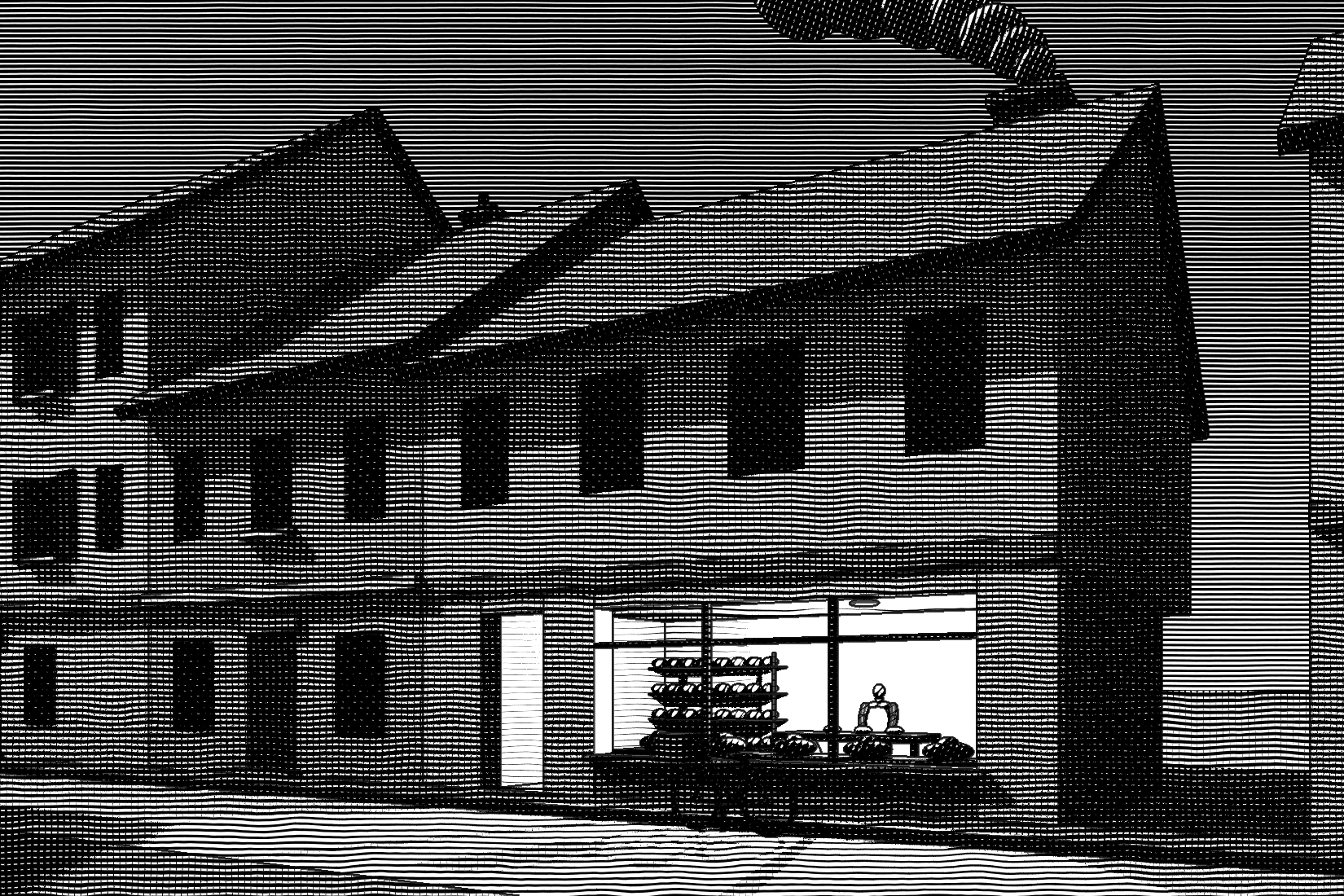
Aske’s, on the high street of Little Varne, at about 3 a.m. It is the last bakery left in the Varne valley. Engraving by Sunniva Holt
Wyn Aske’s alarm is set for 1:15 a.m., and in 31 years it has never once gone off while she was still asleep. She is usually awake at ten past, lying in the dark, waiting for it. “It’s for show,” she says. “Like a smoke alarm. You don’t want to need it.” By 1:40 she has walked the 60 yards from her front door to the back door of the bakery on the high street of Little Varne, put on the lights and lit the oven, and for the next four hours hers is the only lit window in the village.
The oven is a three-deck gas oven installed by her father in 1989, and it takes 50 minutes to come up to 460 degrees. While it does, Wyn turns on the radio, low, to an overnight station that plays dance-band records and, at three, takes calls from insomniacs about their gardens. She lifts the sourdough out of the walk-in fridge, where the loaves have been rising slowly in their baskets since five the previous afternoon, and starts the mixer on the white. The night’s list is chalked on a board by the door: 60 tin loaves, the plain white bread most of Little Varne actually eats; 30 bloomers; 40 sourdough; and 320 rolls, of which 60 are for the care home, 80 for the primary school and the rest for whoever comes.
Ruth Hollis is a senior writer who covers work, craft, and the small places that larger stories tend to skip—village bakeries, repair cafés, lighthouse towers, and a cinema rebuilt one seat at a time. She spent seven years as a deckhand on the Port Ellery ferry before turning to journalism, and her first book, Open Until Six, followed a year in the lives of 12 coastal shopkeepers. She still lives in Port Ellery, takes notes in a shorthand nobody else can read, and always buys something from the people she interviews.
The mill closed, the bank left and the post office became a flat. On Saturday mornings, a folding table in the old library still fixes about forty things.
The sourdough is the newest thing in the shop and also the oldest. Wyn began selling it in 2016, when weekend visitors started asking, but the starter is the one her father kept in a stoneware crock from 1974, when the baker he had trained under in Halbridge gave him a cupful wrapped in a tea towel. A starter is only flour and water, left long enough for wild yeasts and bacteria to move in; fed every day, it can outlive the people feeding it, and a spoonful goes into every batch. The village calls her sourdough “the sour one” and buys it, she reckons, half out of conviction and half out of loyalty. She refuses to give the starter a name. “It’s flour and water,” she says. “It doesn’t need a name. It needs feeding.”
By a quarter to three the sourdough is in the oven and Wyn is shaping, which she does faster than seems reasonable and without looking: a pull, a fold, a quarter turn on the bench, and the dough tightens under her palms into a ball that holds its shape. She is 58, short and strong, with forearms like a rower’s and a burn scar on her left wrist from 1997 that she calls “the bad Tuesday.” She talks while she works, mostly about the dough. Wet weather makes it slack. Cold makes it sulk. In November, when the bakery is cold at two and very hot by four, she adjusts the temperature of the water in each mix by a degree or two, by feel, and has never written down how.
Over the course of the night she made me four cups of coffee and drank none herself. Wyn drinks hot water, from 1:40 until noon, out of the same chipped mug. Coffee, she says, is for people who have to stay awake. She is simply awake, the way other people are simply tall. She goes to bed at seven every evening, which is why her name is on seat F7 at the Picture House, the village cinema that reopened last year, and why she has never sat in it.
Who knocks
At four the tins go in, then the rolls in waves, and the smell, which has been building for two hours, finds its way out under the front door and down the high street. At half past five Wyn unlocks the back door for anyone who knows to knock. At 5:48 the first knock comes. Shaun Kettering is 41 and drives a parcel van out of a depot near Halbridge. His round starts in Little Varne at six, which means he leaves home at 4:50 and has, by the time he reaches the bakery, been awake for two hours and eaten nothing. He buys a sausage roll and whatever is hottest and eats both standing in the doorway with the engine running. “There’s nothing open between the depot and here,” he says. “Not a gas station. Not a machine. This is it.” He has 140 drops today. The first is three doors down.
Other knocks follow. A dairy farmer from up the valley who has been milking since four. The care home’s van, for its rolls, at a quarter past six. A man walking an old deaf terrier, who has passed the bakery at this hour every morning since his wife died and who never buys anything, but taps on the glass and waits for Wyn to wave. Dilys, who runs the counter, at half past six exactly, with her own key and her own opinions about the radio station, which she changes.
At 7:12, Abi Mensah comes in out of the dark in a navy tunic under her coat. She is 36 and a nurse at the Larches, the care home at the top of the village, where the night shift ends at seven. She has been on her feet for 12 hours, and her two children are at home asleep with their father. She buys a tin loaf and four iced buns for their breakfast, which she will not be awake to see. “This is my handover,” she says, lifting the bag. “I give them bread, I go to bed.” The 60 rolls the van collected at a quarter past six will be on her residents’ breakfast trays by eight. By then she will be asleep.
Wyn knows nearly everyone who comes in by what they buy, and a good deal else by what they stop buying. When a standing order drops from a large loaf to a small one, someone has left home, or died. When it rises to three iced buns, someone is pregnant, often before her mother has been told. In February 2023, when an elderly customer missed two mornings running, Wyn walked up the hill with a loaf at eight and found her on the kitchen floor with a broken hip. “I’m not a social service,” Wyn says. “I’m a shop. But the shop’s open when nothing else is, and people notice what’s missing.”
The last one left
When Tom Aske opened the bakery in 1971, there were 11 bakeries in the villages along the Varne valley, one in nearly every place with a church.* By 2000 there were four. The last of the other three closed in 2016, when its owner retired and nobody wanted to buy a business that starts at two in the morning and competes with supermarket bread sold for less than the flour in it. Aske’s is the only one left. On Saturdays people drive in from villages that used to have their own.
It is not a business anyone would start now. Flour has nearly doubled in price since 2021, and the gas for the oven, which burns from 1:40 until 11 every day but Sunday, is the largest bill after wages. A tin loaf at Aske’s costs 3.20 crowns; the supermarket in Halbridge sells one for 1.10. Wyn survives on orders she can count on, from the care home, the school and the pub’s weekend sandwiches, and on the Saturday sourdough, which weekend visitors buy at seven crowns without blinking and which, she says, pays for the tins. She has one son, an accountant in Corran, who has been through the books and suggested, kindly, that she stop. “He’s right,” she says. “He’s an accountant. They’re always right. That’s why nobody invites them anywhere.”
There is no apprentice. She advertised in 2019 and again in 2023 and had one applicant, who lasted four nights. Asked what will happen when she stops, Wyn shapes three more rolls before she answers. “Somebody will have to want to get up,” she says. “That’s all it is. The rest you can learn.”
The first light
What a bakery means to a village is not, mostly, bread. People in Little Varne could buy bread in Halbridge, and plenty do. It is the light. Drivers coming over the hill in the small hours can see it from a mile off. Shift workers walking home see it and know that somebody else is up. In the winter of 2013, when a storm took the power out across the valley for three days, Wyn baked by generator in a headlamp, and people walked down the high street at four in the morning just to look in. “I thought they’d come for bread,” she says. “They hadn’t. They’d come to see if I was here.” She brushed the flour off her hands. “I was here. Where else would I be?”
They’d come to see if I was here.
— Wyn Aske
Dawn came at about twenty past seven, gray and then less gray. By then the shop was open, Dilys was at the till, there was a line out of the door, and lights had come on all along the high street: the convenience store, the school kitchen, the apartment over the pharmacy, a dozen bedroom windows. The bakery’s was one among many, no brighter than the rest, and from the top of the hill you would no longer have picked it out. Wyn seemed to regard this as the night’s real achievement. Her job, as she sees it, is not to be the only light. It is to be the first.
She would be home by one and in bed by seven, and the alarm would be set, as it always is, for 1:15. She would be awake at ten past, lying in the dark, waiting for it.
Notes
*Bakery counts are from the Varne Valley Chamber of Trade directory for 1971 and the district council’s business register for 2000 and 2025. The 11 bakeries of 1971 employed, between them, 46 people. Aske’s employs two, one of whom is Wyn. ↩