A classic gets a new translation every generation. Its newest translator explains what each of her predecessors got right, and why she still started over.
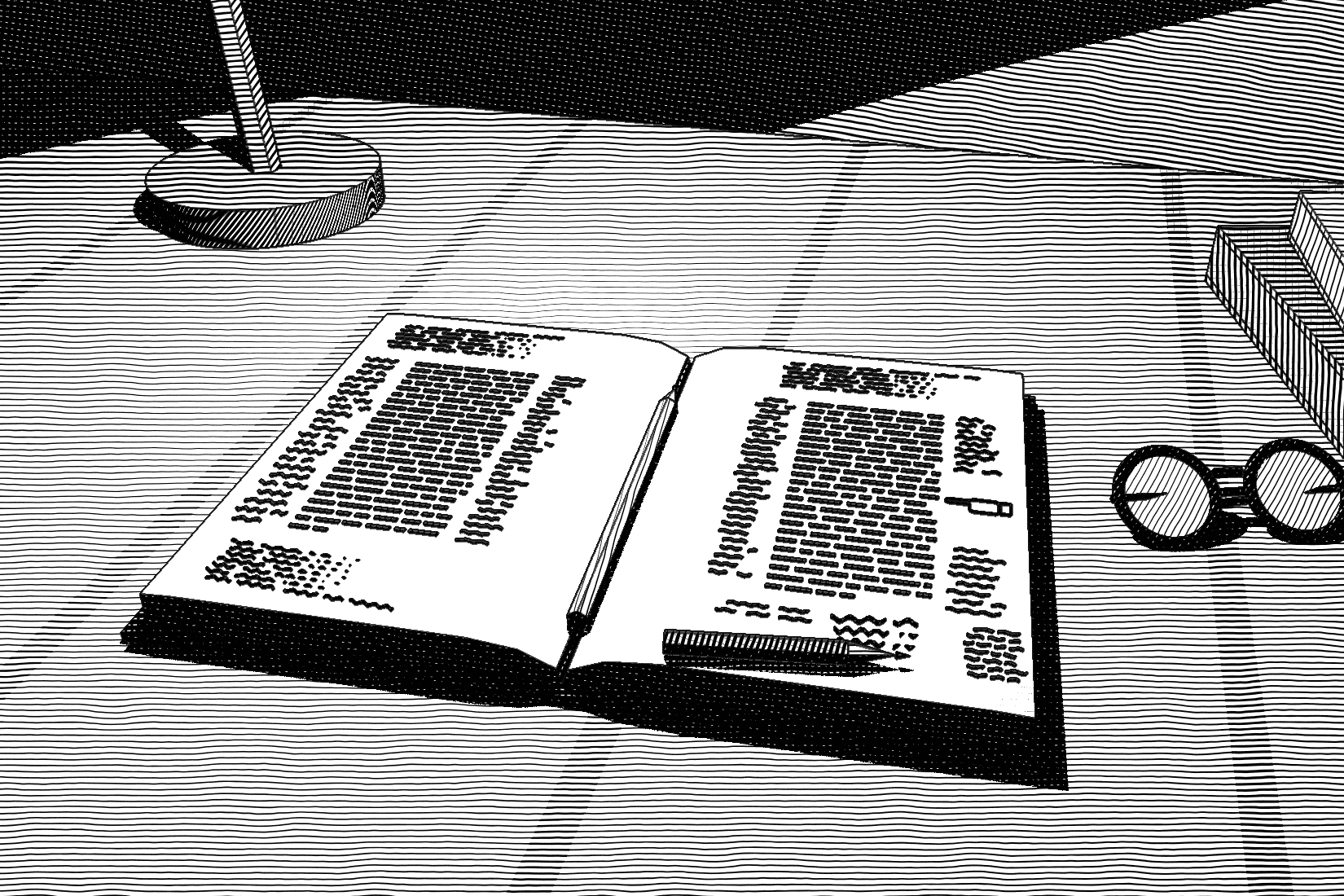
Noor Callender’s kitchen table in Westmere, where the newest English version of a 145-year-old novel was drafted, one sentence at a time. Engraving by Ottilie Marsh
The first sentence of The Weir House is 11 words long in the original Vellan, and Noor Callender has spent, by her own reckoning, about 140 hours on it. She has written it on the backs of envelopes and on a steamed-up bathroom mirror. She has read it aloud to her cat, to her mother, and once, from a footbridge in the valley where the novel is set, to the river Lanne itself, which did not reply but did, she says, make the right noise. In the version that opens her new translation, published this month by Gannet Press in Halbridge, it is 14 words long. She thinks it is nearly right.
Haldverrin—literally “house-weir”—was published in 1881 by Teodor Ansvald, a customs clerk turned novelist, and has never been out of print in Vell, where schoolchildren are made to read it at 15 and most adults claim, falsely, to have reread it since. It follows three generations of the Orrin family, who keep a weir on the Lanne and so control the water for six mills downstream, and who are much better at holding things back than at letting them go. In English it has had four translations in 123 years: Edith Farrant’s in 1903, Lionel Asher’s in 1938, Walter Prentice’s in 1977, and now Callender’s. Each generation, it seems, gets the Weir House it deserves, or at least the one it can bear.
Funmi Adeyemi is the magazine’s critic at large, writing on film, music, and museums, and on the people who keep all three from falling apart. For nine years she programmed the Lantern, a repertory cinema on the Halbridge waterfront, and her essay collection The Dark Between Reels won the Calloway Prize for criticism. She lives in Halbridge, in an apartment with more film cans than chairs, and makes a rule of seeing everything twice: once from the front row, once from the back.
The mill closed, the bank left and the post office became a flat. On Saturday mornings, a folding table in the old library still fixes about forty things.
Here, so you can judge for yourself, is the problem. In Vellan the sentence runs Hald or verrin vatta sen hevrade, sá ennar temmi sen hevrade, which a literal gloss renders as House at weir water its kept, as people words their kept. The verb, hevra, appears twice, ends both clauses, and carries the whole book. It means to keep, as you keep a promise. It also means to hold back, as a weir holds back a river, or a person holds back what she knows. A Vellan reader hears both at once, and the novel spends 400 pages finding out which one the Orrins mean.
Four ways to keep a river
Edith Farrant, a clergyman’s widow who learned Vellan while her husband served as chaplain to a shipping line in the 1880s, chose the promise. Her version reads: The house beside the weir was a faithful steward of the waters that flowed about it, as its inhabitants were faithful to every word that they had given. Callender laughs when she reads it aloud, since it is more than twice the length of the original and sounds as though it is wearing a hat. But she defends it fiercely. Farrant, alone of the four, knew how a 19th-century household ran: what was kept in which cupboard, what you called the cloth you strained milk through, how a maid addressed the daughter of the house. “Her nouns are perfect,” Callender said. “I stole a dozen.” What Farrant could not do was leave the darkness in. She cut chapter 19, in which Sanna Orrin’s pregnancy is discovered, and replaced it with a single sentence.
Lionel Asher, a poet, chose the other meaning, and in the process gave the book its English title. The weir held back the river, and the family held back everything else. It is a terrific sentence, and it is not Ansvald’s. Asher moved the keeping from the house to the weir, dropped the promise altogether, and supplied a menace the original only implies. His whole translation is like that: quick, funny where Ansvald is funny, frightening in the right places, and for 40 years it was the version people loved. It also owed, as his letters to his publisher make clear,* rather more than he admitted to his landlady. “He had the ear,” Callender said. “He didn’t always have the language. Every so often you can see him guessing, and he guesses beautifully.”
Walter Prentice, a philologist, set out in 1977 to correct them both. He restored chapter 19. He translated the text, the whole text, and nothing but the text. The house at the weir retained its water, as its people retained their words. Then, at the foot of the page, he spent 112 words explaining that hevra can also mean to keep a promise. “Walter is never wrong,” Callender said, with real affection. “And he is never once alive. ‘Retained.’ Nobody in the history of the world has felt anything about the word ‘retained.’” His is the edition still assigned in classrooms, and therefore the one most English readers have met, often, Callender suspects, for the last time.
Why she started over
The usual case for a new translation is that translations age and originals, mysteriously, do not. To a Vellan reader Ansvald’s prose has hardly dated since 1881, while in English Farrant now sounds like a rectory, Asher like a radio play, and Prentice like a seminar. Callender has a line for this: “Every translation is a letter to its own decade. You can read the postmark.” But that, she says, is not why she agreed to do it.
Every translation is a letter to its own decade.
— Noor Callender
The real reason was a box. In 2021 Ansvald’s great-great-granddaughter sold the family’s papers to the Vell National Library, and among them were the manuscript of the novel and the printer’s proofs of the first edition. All three earlier translators had worked from the revised edition of 1890, which Ansvald prepared in middle age under pressure from his publisher and, it now appears, from his wife. The revisions are small, some 300 of them across the book, but nearly all of them lean the same way. Ansvald softened the ending. In 1890, Sanna Orrin opens the sluice and lets the river through. In 1881, she keeps it shut.†
That changes the book backward, Callender says, all the way to the first sentence. In the revised edition the novel ends with a letting go, and its opening reads, in hindsight, as a description of something that will be overcome. In the first edition the last word of the novel is hevrade, kept, and the first sentence turns out to be not a setup but a verdict. The house keeps; the people keep; both meanings are true, and neither is redeemed. “I needed an English sentence you could read twice,” she said, “once at the beginning and once at the end, and that would mean something worse the second time.”
A pebble in the shoe
Her method is strict and faintly monastic. She does not reread her predecessors until she has a full draft of her own; their books live on a shelf in the hallway, “where they can’t hear me.” She translates the last chapter first, so that she knows where every sentence is heading. She writes what she calls an ugly draft, fast (The Weir House took 11 weeks, at about 2,000 words a day), and then revises it four times, the last of them entirely aloud. And she keeps a ledger of refusals, a notebook of English words she has decided the book must not contain, because they would date it, flatter it, or explain it. Retained is on the list. So, she admits, are sorrows and menace.
Then, in the 11th week, she came back to the first sentence with the last one in her hand. Her version reads: The house at the weir kept its water, as its people kept their words. At first glance it looks like Prentice with the Latin taken out. The difference is a single letter. In English you keep your word, singular, when you honor a promise; to keep your words, plural, is not an idiom at all, and the ear catches on it for a fraction of a second. In that fraction, Callender argues, a reader hears both meanings: the promise first, and then, just behind it, the withholding. “It’s wrong in exactly the right way,” she said. “It’s a pebble in the shoe. You keep walking, but you know it’s there.”
The novel’s last sentence, in her version, closes on the same verb: Sanna went down to the sluice in the gray before morning, laid her hand on the wheel, and kept it. Read it, turn back to page one, and the pebble is still there.
Only once she had finished did she take the three older translations down from the hallway shelf and read them through, one a week. She changed three sentences as a result, one for each of them: a noun of Farrant’s for the bread oven, a line of Asher’s dialogue she could not better, and one of Prentice’s footnotes, which she turned into a sentence of the novel and has credited to him in her afterword. She assumes, cheerfully, that she will be replaced. Somewhere, she says, there is a teenager being made to read Prentice for school and hating every word, who will do the whole thing again around 2060. “I hope she reads me last,” Callender said, “after her own ugly draft. I’ll be on the shelf in the hallway, keeping my words.”
Notes
*Asher’s letters to his editor at Gannet Press, 1936–1938, are held in the press’s archive in Halbridge and are quoted in Callender’s introduction. In one, he asks for an advance to cover “Mrs. Halde’s coal, which is to say, chapter 12.” ↩
†The comparison of the two editions draws on Callender’s afterword and on a collation published by the Vell National Library in 2023, which records 312 substantive revisions between the 1881 and 1890 texts, 41 of them in the final two chapters. ↩