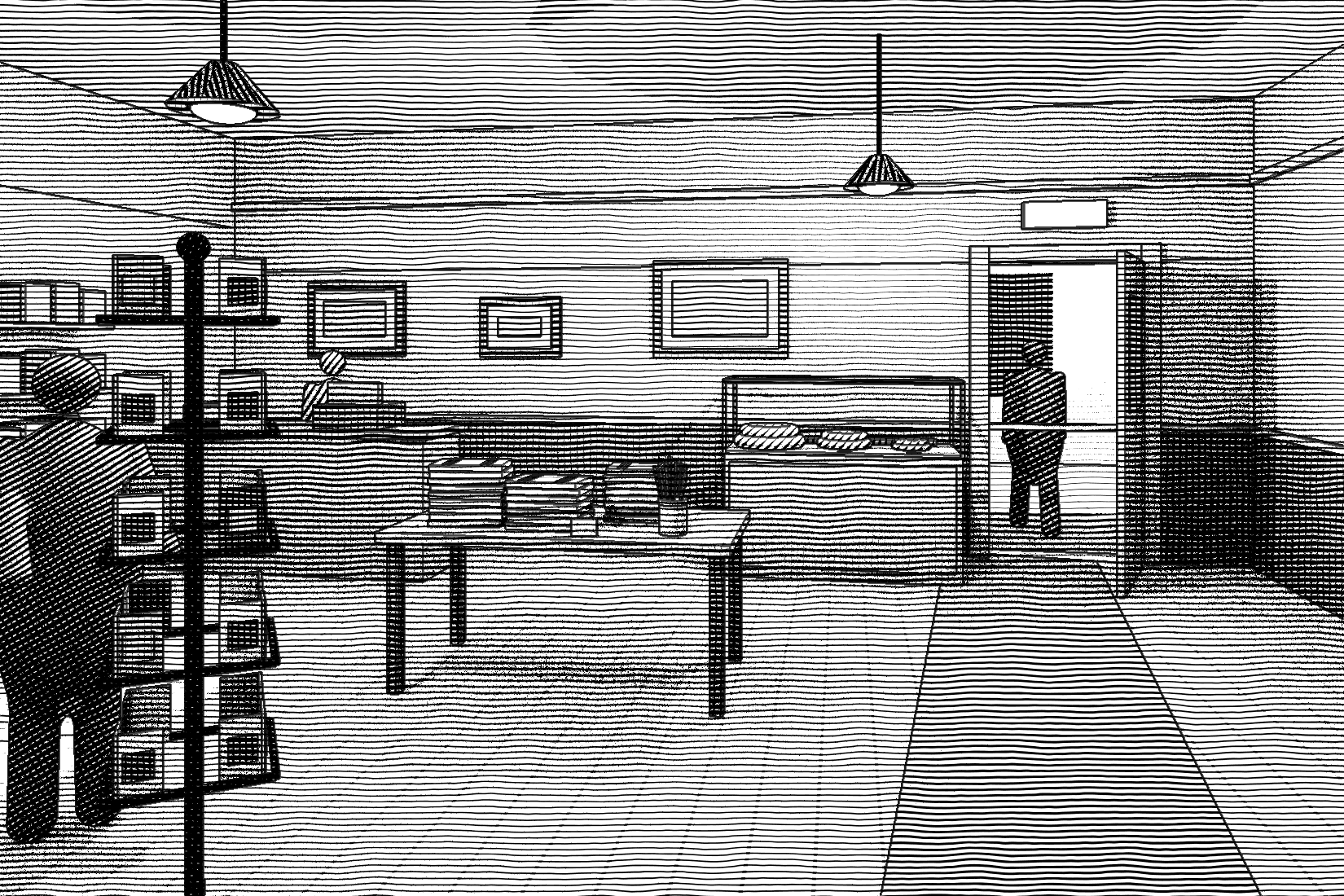
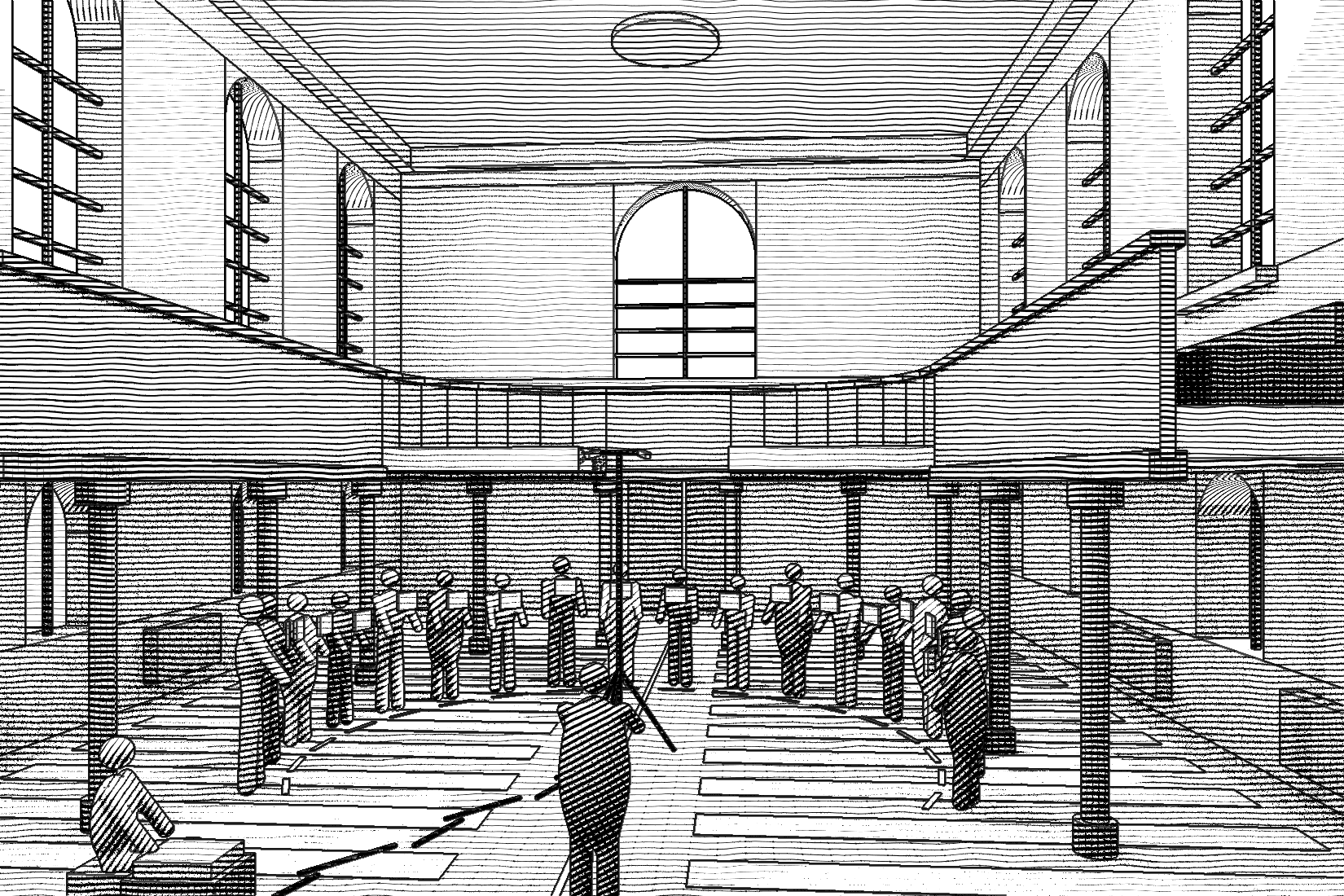
The last room: at the Port Ellery Ropewalk, as almost everywhere, the shop stands between the final display case and the way out. Engraving by Bram Keller
Colin Mayhew opens his sample case the way a jeweler does, slowly, so that you can see what you are being offered. On a Tuesday in June, on a trestle table in the back office of the Halbridge Customs House Museum, it fell open to reveal, in fitted gray foam, the last room of almost every small museum in the country. A pencil, gold-stamped. A ruler with a timeline running down one edge. An eraser shaped like a castle. A tea towel folded to the size of a paperback, a fridge magnet, a bookmark with a tassel, a pack of postcards, a mug, and a small cotton bag printed with the words I went to the museum, with a blank space beneath it for the museum to say which.
“Everyone thinks they’re different until they see the case,” Mayhew said. He is 63, a sales representative for Mallory Heritage Supply of Corran, and he has spent 31 years driving these objects around the country in the back of a succession of station wagons, to museums of rope, lace, tin, trams, lifeboats, bells, cheese, and, in one case, sewage. Mallory’s catalog runs to 3,800 lines. About 400 of them can be stamped, printed, or embroidered with a museum’s name, and it is those 400, in various combinations, that you have bought at the end of every rainy Saturday of your life.
Funmi Adeyemi is the magazine’s critic at large, writing on film, music, and museums, and on the people who keep all three from falling apart. For nine years she programmed the Lantern, a repertory cinema on the Halbridge waterfront, and her essay collection The Dark Between Reels won the Calloway Prize for criticism. She lives in Halbridge, in an apartment with more film cans than chairs, and makes a rule of seeing everything twice: once from the front row, once from the back.
The mill closed, the bank left and the post office became a flat. On Saturday mornings, a folding table in the old library still fixes about forty things.
The Customs House Museum, which occupies three rooms of an 1840s building on the Halbridge quay and admits about 9,000 visitors a year free of charge, was placing its summer order. Its treasurer, Pauline Garvey, 71, went down the list with a pencil (not, she pointed out, one of theirs) while Mayhew advised. Yes to the pencils, 250 of them. Yes to the castle erasers, though the museum is about customs duties and has never had a castle. No to the mug. “Mugs break in the post and they break in the shop,” Mayhew said. “Mugs are a lifestyle.”
The pencil economy
The economics of the last room are stranger than they look, and the first strange thing is how much they matter. For a museum like the Customs House, which charges nothing at the door, the shop is the only place a visitor can pay for anything except by dropping coins into a clear plastic box. A 2025 survey of 212 small museums found that the shop supplied a median 29 percent of their earned income, more than admissions, room hire, or the café, where there is one.* The same survey found that 93 percent of them sold a pencil.
The second strange thing is the margins, which are spectacular and almost useless. A personalized pencil costs the Customs House 0.31 crowns and sells for 1.20 crowns. Postcards arrive at 0.19 crowns each, in runs of 500 per design, and sell for 1.25 crowns, a gross margin of 85 percent that a supermarket could only dream of. But a small museum sells postcards at a rate of about one a day, spread across a dozen designs, and the Customs House’s favorite, a hand-tinted view of the quay in 1890, has been on the rack since 2021 and has faded in the window to the color of weak tea. Margin is what you make on a thing. It is not much use if the thing never leaves.
The third strange thing is the book. Every small museum has one: a history of the building, usually written by a retired volunteer, usually with a foreword by someone who once chaired the trustees. The Customs House printed 1,500 copies of A House on the Quay in 2008, because that was the number at which the printer’s price per copy fell off a cliff. Eighteen years later, 1,120 of them are in the attic, in boxes the volunteers have stopped noticing. At the current rate of about 21 sales a year, the last copy will leave the building in 2079.† “Every museum wants a book,” Mayhew said. “No museum wants 600 books.”
Why the pencil, then? Mayhew’s answer is children. The survey puts the average spend of a family in a small museum shop at 7.80 crowns, and the largest single share of it is spent by someone under 11 with a fistful of coins and a strong sense of occasion. Items under five crowns account for nearly two-thirds of transactions, and the pencil is the ideal form of the under-five-crown item: cheap, unbreakable, easy to mail, and unmistakably a souvenir, since nobody needs a pencil and every child already owns several. “It’s the most honest object in the building,” Mayhew said. “Nobody needs it, and everybody buys it.”
The compromise pencil
Annika Fairlie tried to do without it. Fairlie, 44, has been the curator since 2017 of the Port Ellery Ropewalk, a brick shed 330 yards long in which rope was made, by spinners walking backward as they twisted, from 1791 until 1968. When she arrived, its shop was a Mallory shop: castle erasers, lighthouse magnets (the ropewalk is many things, but not a lighthouse), and a tea towel bearing a drawing of the building so long and thin that it looked like a draft stopper. In the winter of 2019 she boxed the lot up and sent it back.
In its place she put things that could only have come from the ropewalk. Volunteers make dog leads on the building’s 1870s laying machine, from the same three-strand hemp it has always made, and sell them for 18 crowns. There is a card printed with 12 knots and the names the rope-makers gave them, several of which are unprintable and therefore appear in their polite versions. The postcards are not views of the building but photographs from its archive: women spinners in 1904, looking straight into the lens with the expressions of people who have been asked to stop working for a photograph and are not being paid for the time. And instead of a book there is a 32-page booklet Fairlie wrote herself, printed 200 at a time. “I had seen other people’s attics,” she said.
Her first year was a disaster. Shop income fell by nearly a third, and Fairlie, watching from behind the till, saw why. Children came into the last room, scanned it for something they could buy with what they had in their pockets, found nothing, and left bereft. Adults buy things for themselves at a museum. Children buy proof. So in 2021 she brought back a pencil, with a four-inch length of the ropewalk’s own twine knotted around the top, and the staff call it, without affection, the compromise pencil. It is now the shop’s second-best seller. By 2025 the shop was earning 70 percent more than it had in 2018 and supplying 41 percent of the museum’s earned income. The dog leads, of which it sold 1,300 last year, are now so common on the Port Ellery seafront that locals use them to spot visitors.
Proof of an afternoon
Spend enough time in museum shops and they begin to look less like retail than like ritual. A museum visit is a peculiar kind of leisure: voluntary, mildly improving, and usually undertaken because it is raining or because the children need to be somewhere. The galleries ask you to remember other people’s lives. The shop, which you cannot avoid because it stands between you and the door, asks something simpler: whether this was a good afternoon, and whether you would like something to prove it. Souvenir is only the French for remembering. What the last room sells is not the rope, or the customs duties, or the building. It is the day.
Fairlie puts it more bluntly. “Nobody comes to a rope museum because they’re interested in rope. They come because it’s Saturday,” she said. “The shop is where they decide whether it was a good Saturday.” That, she now thinks, is why the catalog shop survives, and why it is not quite the failure of imagination it looks like. A tea towel with a drawing of a building is a poor souvenir of a collection and a perfectly good souvenir of a trip. It is useful, it folds flat in a suitcase, and every time you dry a plate with it you are briefly back in the place where you had a day off. Asked which of the old Mallory lines she misses, she admitted, after a long pause, the tea towel.
The shop is where they decide whether it was a good Saturday.
— Annika Fairlie
Mayhew finished at the Customs House a little after noon, closed his case, and politely declined a copy of A House on the Quay. He has never bought anything from a museum shop, he said, but he has kept something. In a kitchen drawer at home in Corran there is one of every pencil he has ever sold, a little over 600 of them, identical in every respect except the name stamped in gold along the side. Lifeboats, lace, trams, the castles that are not castles. He keeps a photograph of the drawer in his wallet, and he took it out to show me, which is the only time I have seen a grown man carry a picture of his stationery. “It’s all the same pencil,” he said. “But every one of them was somebody’s Saturday.”
Notes
*Small Museums Network, Trading Survey 2025, based on returns from 212 member museums with fewer than 25,000 visitors a year. Median shares of earned income: shop 29 percent, admissions 24 percent, room hire 11 percent, and, for the 61 museums that run one, café 18 percent. Items priced under 5 crowns made up 64 percent of shop transactions but only 27 percent of shop revenue. ↩
†From the Customs House Museum’s stock records, supplied by its treasurer. The 2008 print run cost 6,900, crowns or 4.60 crowns a copy, and the book sells for 12 crowns. At the present rate of sale it will recover its printing bill in about 2035. ↩